by Jason Joyner | Oct 4, 2007 | Biblical worldview, Blog, fiction, writing craft
Real Christians don’t get “pissed off,” they have “righteous anger.” Or perhaps disconcerted, infuriated, or provoked might be better.
I was checking out the new design for the Relief Journal (cool new digs gang!), when I read a post from the editor. He talks about a little controversy regarding Reconstructing Natalie, by Laura Jensen Walker. Apparantly a site called The Timothy Report is run by a pastor/webmaster/Christian book store employee. He had the book by Ms. Walker brought to him by a distraught customer, because the main character is battling breast cancer and gets “pissed” at some point, or says she’s “pissed off.” So this gentleman is posting a notice on his site to complain to Thomas Nelson, the publisher, if other people are tired of such lines being crossed in Christian fiction. The charge is that this book is lower standards for the CBA.
This reminds me of the discussion I had concerning the “Christian Marketplace.” Now this person is responsible for this book not being available at his bookstore and making it sound like it is some horrible tome, corrupting people as they read it. It is frustrating to see a book about a subject that really is ripe for use in Christian fiction, yet it is torn down for a choice of one word.
*Cough* Excuse me, I think I just choked on a gnat…
I haven’t read Reconstructing Natalie, so I don’t know if it is any good as fiction, as a work of art. I do know that I wouldn’t condemn a book on the choice of one word like in this situation. What I did do is write the editor listed on the Timothy Report and supported her for producing fiction willing to tackle difficult subjects.
/end rant
You can see the letter in question at the Timothy Report here.
You can find the original post at Relief here (look for the second part of the post):
by Jason Joyner | Oct 2, 2007 | arts, Blog, fiction, football, TMQ
One of my internet highlight of the week is Tuesday Morning Quarterback, the ESPN football column by Gregg Easterbrook, who is a Brookings Institute scholar, editor of the Atlantic Monthly, and an astute football fan who writes an entertaining pigskin screed that changed the way I watch the game. My buddy Mark has quoted TMQ before on his blog. I don’t blog about football much (how bout them Cowboys, Nicole?), but this aside he wrote was very pertinent regarding art now and 50 years ago:
In world news, there’s a harmonic convergence of golden anniversaries in progress. The upcoming 50th anniversary of Sputnik joins the 50th anniversaries of the Edsel, “West Side Story” and the publication of “Doctor Zhivago.” As the Sputnik anniversary arrives, bear in mind what a bucket of bolts the first artificial satellite was — little more than a radio transmitter, it looked like something a 16-year-old made in metal shop for a school play. America’s Explorer I, which followed Sputnik I into orbit a few months later, was also a bucket of bolts. Although even with its rudimentary instruments and vacuum tubes — remember, humanity landed on the moon before the invention of the pocket calculator — Explorer I discovered the Van Allen belts. And of course the Edsel was a bucket of bolts, an odd snoot being the least of its problems.
Although the great technical achievement of 1957 — the artificial satellite — and the main consumer-industrial product of that year — the Edsel — seem crude in retrospect, great artistic achievements of that same year, such as “West Side Story” and “Doctor Zhivago,” seem magnificent in retrospect. You have to know the history of Broadway musicals to understand what an original and significant work Leonard Bernstein’s “West Side Story” was, although you need not know that history to appreciate the music, lyrics and dialogue. “Doctor Zhivago” numbers among the greatest books ever written, and that’s even if you can’t grasp how much better the poetry sounds in Russian, as Russian speakers assure us. Boris Pasternak summed up all his experiences in the dashed hopes of the Russian Revolution in the tragic story of a poet who loses his muse-love. Pasternak then declined the Nobel Prize for literature because, being a critic of the Kremlin, he knew he would never be allowed back into the Soviet Union if he went to Sweden to accept the prize. And, like Zhivago, he died too soon, passing away just two years after the book was published. “Doctor Zhivago” became an international bestseller — When was the last time the top-selling book of the year was great literature? — and was made into one of the last really good Hollywood movies, three hours long and actually faithful to the book! (On buying a book, Hollywood’s first move today is to alter everything except the title; Mel Gibson even altered the gospels and invented composite characters for his Jesus movie, Gibson figuring he had a better sense of story than God.)
Now think what has happened in technical and artistic trends in the 50 years since 1957. Scientific endeavors have made fantastic strides in quality, complexity and significance. Consumer product quality has increased dramatically — new cars are packed with features unknown in 1957 yet are far safer and more reliable, and the cell phone in your pocket and the computer you’re reading this on, to say nothing of the Internet it’s transmitted over, would have been viewed as supernatural by the engineers who built Explorer I. At the same time, the quality of art has plummeted. There hasn’t been a musical of artistic merit to open on Broadway in many moons — right now, it’s all vapid dreck. (In fact, I think the show “Vapid Dreck,” based on a remake of a remake, opens at the Brooks Atkinson soon.) And although good books are still written, what truly great novel has been produced in the past decade or two? Fifty years ago, technical stuff was buckets of bolts and art was splendid; now, the technical stuff is splendid and the art is in poor repair. This tells us something — I just wish I knew what.
by Jason Joyner | Oct 2, 2007 | arts, Blog, fiction, football, TMQ
One of my internet highlight of the week is Tuesday Morning Quarterback, the ESPN football column by Gregg Easterbrook, who is a Brookings Institute scholar, editor of the Atlantic Monthly, and an astute football fan who writes an entertaining pigskin screed that changed the way I watch the game. My buddy Mark has quoted TMQ before on his blog. I don’t blog about football much (how bout them Cowboys, Nicole?), but this aside he wrote was very pertinent regarding art now and 50 years ago:
In world news, there’s a harmonic convergence of golden anniversaries in progress. The upcoming 50th anniversary of Sputnik joins the 50th anniversaries of the Edsel, “West Side Story” and the publication of “Doctor Zhivago.” As the Sputnik anniversary arrives, bear in mind what a bucket of bolts the first artificial satellite was — little more than a radio transmitter, it looked like something a 16-year-old made in metal shop for a school play. America’s Explorer I, which followed Sputnik I into orbit a few months later, was also a bucket of bolts. Although even with its rudimentary instruments and vacuum tubes — remember, humanity landed on the moon before the invention of the pocket calculator — Explorer I discovered the Van Allen belts. And of course the Edsel was a bucket of bolts, an odd snoot being the least of its problems.
Although the great technical achievement of 1957 — the artificial satellite — and the main consumer-industrial product of that year — the Edsel — seem crude in retrospect, great artistic achievements of that same year, such as “West Side Story” and “Doctor Zhivago,” seem magnificent in retrospect. You have to know the history of Broadway musicals to understand what an original and significant work Leonard Bernstein’s “West Side Story” was, although you need not know that history to appreciate the music, lyrics and dialogue. “Doctor Zhivago” numbers among the greatest books ever written, and that’s even if you can’t grasp how much better the poetry sounds in Russian, as Russian speakers assure us. Boris Pasternak summed up all his experiences in the dashed hopes of the Russian Revolution in the tragic story of a poet who loses his muse-love. Pasternak then declined the Nobel Prize for literature because, being a critic of the Kremlin, he knew he would never be allowed back into the Soviet Union if he went to Sweden to accept the prize. And, like Zhivago, he died too soon, passing away just two years after the book was published. “Doctor Zhivago” became an international bestseller — When was the last time the top-selling book of the year was great literature? — and was made into one of the last really good Hollywood movies, three hours long and actually faithful to the book! (On buying a book, Hollywood’s first move today is to alter everything except the title; Mel Gibson even altered the gospels and invented composite characters for his Jesus movie, Gibson figuring he had a better sense of story than God.)
Now think what has happened in technical and artistic trends in the 50 years since 1957. Scientific endeavors have made fantastic strides in quality, complexity and significance. Consumer product quality has increased dramatically — new cars are packed with features unknown in 1957 yet are far safer and more reliable, and the cell phone in your pocket and the computer you’re reading this on, to say nothing of the Internet it’s transmitted over, would have been viewed as supernatural by the engineers who built Explorer I. At the same time, the quality of art has plummeted. There hasn’t been a musical of artistic merit to open on Broadway in many moons — right now, it’s all vapid dreck. (In fact, I think the show “Vapid Dreck,” based on a remake of a remake, opens at the Brooks Atkinson soon.) And although good books are still written, what truly great novel has been produced in the past decade or two? Fifty years ago, technical stuff was buckets of bolts and art was splendid; now, the technical stuff is splendid and the art is in poor repair. This tells us something — I just wish I knew what.
by Jason Joyner | Oct 1, 2007 | Blog, fiction, non-fiction, writing craft
I’ve been taking a little break from writing over the last several weeks. There were two big events that were drawing my attention: the worship weekend with Noel and Tricia Richards, and I have a major certifying exam for my work that I take in 2 weeks.
I still think about my projects and issues in general, but I’ve definitely been distracted from my usual level of pondering. However, some aspects of creating are not as easy to turn off.
I’m trying to use this time as a step back from what I’ve been working on and seeing what weaknesses I can work on and what strengths to play up. This is happening to a degree, but my brain is not necessarily cooperating. It’s not something I want to turn off anyway.
I’ve been coming up with MORE ideas.
Jeez, brain. Aren’t I having enough trouble tackling the mess you’ve already conjured up for me? No, you like being in a frazzle, so why not choose this particular time to inspire me with projects that could be as worthy of attention as what I’ve been spending the last 2+ years on. Man o’ live!
My wife said something earlier this year that has stuck with me since regarding our kids: write the stories they would want to read. I know my current WIP doesn’t qualify, so I’ve considered some other ideas, one of which seems to be gelling a little. Then Sunday I had inspiration for a possible non-fiction project. Great.
Actually, I’m not complaining. It is good to have ideas to play around with inside my noggin. There’s just too many temptations – which to choose?
by Jason Joyner | Oct 1, 2007 | Blog, fiction, non-fiction, writing craft
I’ve been taking a little break from writing over the last several weeks. There were two big events that were drawing my attention: the worship weekend with Noel and Tricia Richards, and I have a major certifying exam for my work that I take in 2 weeks.
I still think about my projects and issues in general, but I’ve definitely been distracted from my usual level of pondering. However, some aspects of creating are not as easy to turn off.
I’m trying to use this time as a step back from what I’ve been working on and seeing what weaknesses I can work on and what strengths to play up. This is happening to a degree, but my brain is not necessarily cooperating. It’s not something I want to turn off anyway.
I’ve been coming up with MORE ideas.
Jeez, brain. Aren’t I having enough trouble tackling the mess you’ve already conjured up for me? No, you like being in a frazzle, so why not choose this particular time to inspire me with projects that could be as worthy of attention as what I’ve been spending the last 2+ years on. Man o’ live!
My wife said something earlier this year that has stuck with me since regarding our kids: write the stories they would want to read. I know my current WIP doesn’t qualify, so I’ve considered some other ideas, one of which seems to be gelling a little. Then Sunday I had inspiration for a possible non-fiction project. Great.
Actually, I’m not complaining. It is good to have ideas to play around with inside my noggin. There’s just too many temptations – which to choose?

by Jason Joyner | Sep 28, 2007 | Blog, CFBA, fiction
This week, the
Christian Fiction Blog Alliance
is introducing
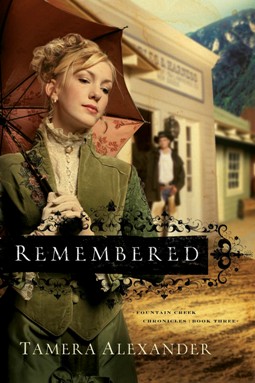
REMEMBERED(Fountain Creek Chronicles, Book 3)
(Bethany House, 2007)
by
ABOUT THE AUTHOR:
 Tamera Alexander is a bestselling novelist whose deeply drawn characters, thought provoking plots, and poignant prose resonate with readers. Alexander’s books have won multiple awards, including Romance Writers of America’s 2007 RITA® for Best Inspirational Romance, the 2007 Gayle Wilson Award of Excellence, 2007 Bookseller’s Best, and Library Journal’s Top Christian Fiction of 2006.
Her books have received acclaim from Library Journal, True West Magazine and Historical Novels Review, and Rekindled debuted on the CBA fiction bestseller list. She has a professional background in business management and conference coordination. A leader of women’s ministries for over twelve years, she is currently active in music ministry, facilitating small groups, and mentoring other women. A graduate of Harding University, Tamera lives with her husband and their two teenagers in Greeley, Colorado.
Her other two books in the Fountain Creek Chronicles are Rekindled (Book 1) and Revealed (Book 2)
To celebrate the release of Remembered, as well as the 3-volume boxed set of Fountain Creek Chronicles (Rekindled, Revealed, and Remembered), Tamera is currently giving away boxed sets in a contest on her website. Check out the contest at http://www.tameraalexander.com/ .
From a Distance, the first book in Tamera’s next historical series (Timber Ridge Reflections) releases in spring 2008.
ABOUT THE BOOK:
 Though loss is often marked
in a single moment,
letting go of someone you love
can take a lifetime…
The threat of war–and a final request–send Véronique Girard from France to a distant and uninviting country. In the Colorado Territory, she searches for the man who has held her heart since childhood–her father. Pierre Girard left Paris for the Americas to seek his fortune in fur trading, vowing to send for his wife and daughter. But twenty-five years have passed and his vow remains unfulfilled. Sifting through shards of broken promises, Véronique embarks on a dangerous search for a man she scarcely remembers.
His grief finally healed, Jack Brennan is moving on with life. After years of guiding families west, he is now working as a freighter to the mining towns surrounding Willow Springs. What he doesn’t count on is an unexpected traveling companion on his trips up into the mountains, and how one woman’s search will cause havoc with his plans… and his life.
“Alexander again delivers a most amazing story. The characters are more than words on the page; they become real people. Though there are French words sprinkled throughout the story, they enhance the emotions rather than distract the reader.” –Romantic Times
“…a rich historical romance by possibly the best new writer in this subgenre.” –Library Journal
“Alexander has done it again with Remembered, third in the FOUNTAIN CREEK CHRONICLES. She’s fashioned characters that are as rich and deep as the mountains and valleys they explore throughout the pages, coloring the story as adeptly as the heroine does her canvas. I was drawn immediately into the ages-old heartaches of both of the main characters, understanding at once Veronique’s reticence to make a place for herself in the unknown wilds of America and Jack’s uncompromising love for this land that he’s cut a swath through time and again. They both have a series of mountains to overcome in the search for Veronique’s father, but I enjoyed watching their faith and appreciation grow with each turn of the page. And woven adeptly through it all is the encompassing truth of the Lord’s sovereignty—that sometimes He takes away, and sometimes He gives us what we need, not what we’re looking for.
Anyone’s who’s read the other Fountain Creek books won’t want to miss this one, but it easily stands alone. The characters will take you by the hand and lead you heart-first into their stories, and by the time they release you at the end, you’ll feel as though you’ve taken up residence just across the Creek from them, as surely as they have in your heart.” –Roseanna White, christianreviewofbooks.com
“Remembered, the third book in the FOUNTAIN CREEK CHRONICLES, takes us back to Willow Creek and revisits beloved characters from the previous two books in the series, Rekindled and Revealed. Tamera Alexander has the remarkable ability to create places, and characters who endear themselves to us, even those just briefly mentioned. If I had lived in the late 1800s, I would love to have met these people and would surely have been inspired by the way they lived out their faith.
Remembered is a delightful read, well-researched and well-written. I expect to see great things from this author in the future.” –Lindsey Freitas, bookloons.com
“Remembered is an absolutely wonderful continuation of the FOUNTAIN CREEK CHRONICLES.” –Amanda Schafer, armchairinterviews.com