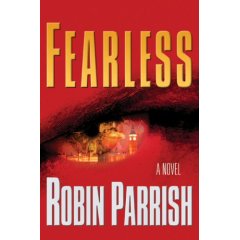
Today we start another CSFF blog tour featuring the novel Fearless by Robin Parrish.
This book was just featured through the Christian Fiction Blog Alliance, which is where my review of Fearless can be found. Something to add would be that this book is hard to categorize as just science fiction or fantasy. It has both elements involved through the story. It should appeal to any fan of speculative fiction in general (Dekker, Peretti, John C. Wright).
Robin’s web site and blog are recommended stops for this tour. He just posted an original graphic novel presentation of a story from the Dominion Trilogy set between books 1 (Relentless) and 2.
Since I’ve posted a review already, I thought about what I could add to this tour. My mind came back continually to the thoughts of heroes. Fearless tracks Grant Borrows and his fellow Ringwearers as they deal with the amazing powers they had developed out of the events of Relentless. Grant especially desires to use his phenomenal powers for good, as his abilities were conceived as a force of evil (or so it seems). A major conflict in the book is Grant dealing with his destiny: can he make good with the gifts he’s been given, or is his destiny foretold and pre-ordained, out of his control?
Why do we have an innate attraction to the ideas of heroes? We ask people who their heroes are. Kids and adults both delight at the stories of superheroes, people with extraordinary powers who seem to save the world again and again. We always like it when a regular person makes good: the local hero who saves someone. Every story needs a hero, doesn’t it?
Our collective imagination seems drawn to the idea of people who have a greater power or call. A look at the top box office of all time for the US and worldwide shows the list dominated by familiar names: Luke Skywalker, Harry Potter, Lord of the Rings, Spiderman, Jack Sparrow. All of these stories feature larger than life figures who overcome overwhelming odds to triumph.
I’ve always day-dreamed of some cataclysm happening in my regular life, only to find that I could fly, had super something-or-other in order to save those in peril. It’s in the fabric of who I am. I grew up on Star Wars and Super Friends, and this summer I couldn’t wait until the latest Spiderman movie came out. Recently I’ve gotten back into enjoying comic books, which shows different aspects of heroes from when I was growing up. Nowadays these heroes struggle against inner darkness or temptation and deal with more real life scenarios over the classic comics when Superman never doubted what was right and was always there to save Lois Lane.
I know that some people prefer down to earth heroes in their entertainment – the cop, the spunky Nancy Drew type, people who don’t have a special ability. Others may even prefer the “anti-hero”, the character that may otherwise be very unlikable in a story, but is portrayed from a sympathetic viewpoint. However, in general we are drawn to those who are greater than us in both their abilities and trials. I could go on, reaching back to mythology and stories of Hercules, Achilles, and so on, but I think this point is coming across.
Having made the argument that this desire is there, now we may ask “Why is it there?”
Could it be, perhaps, that it speaks to who we are? Does it draw from our deepest heart and unconscious needs?
I would argue that heroes are so compelling because we need a hero. We realize, whether directly or subconsciously, that we cannot overcome all that we encounter on our own. Try as we might, we are not able to complete our own salvation. We may fight valiantly, but our struggle is ultimately doomed against the supreme villain.
In the end, this attraction to heroes points us to the one who fought evil without ever turning to temptation. He went toe-to-toe with our greatest foe on our behalf. He sacrificed himself in defending truth, justice, and mercy. And when all seemed lost, he rose in even greater power and strength for the ultimate victory.
Jesus is my hero.
Fearless may not be an overtly Christian novel. This is fine with me, as I don’t require every story to have an overt religious element in order to be a good story. I think Robin taps into this intrinsic need for a hero with his story. I am eagerly anticipating the third book Merciless (seriously Robin – you need a proofreader, I’m all over it…) and I wonder what the ending will hold. I can’t allegorize what he’s written, partly because that’s not his intention, and I don’t know how the story will work out. It still speaks of this great human conflict, the desire to rise up over the insurmountable odds. The heart of the gospel speaks to this, and that’s what makes heroes a powerful story element, especially to a Christian writer.
—
Check out my fellow tourmates for other features of Fearless:
Today we start another CSFF blog tour featuring the novel Fearless by Robin Parrish.
This book was just featured through the Christian Fiction Blog Alliance, which is where my review of Fearless can be found. Something to add would be that this book is hard to categorize as just science fiction or fantasy. It has both elements involved through the story. It should appeal to any fan of speculative fiction in general (Dekker, Peretti, John C. Wright).
Robin’s web site and blog are recommended stops for this tour. He just posted an original graphic novel presentation of a story from the Dominion Trilogy set between books 1 (Relentless) and 2.
Since I’ve posted a review already, I thought about what I could add to this tour. My mind came back continually to the thoughts of heroes. Fearless tracks Grant Borrows and his fellow Ringwearers as they deal with the amazing powers they had developed out of the events of Relentless. Grant especially desires to use his phenomenal powers for good, as his abilities were conceived as a force of evil (or so it seems). A major conflict in the book is Grant dealing with his destiny: can he make good with the gifts he’s been given, or is his destiny foretold and pre-ordained, out of his control?
Why do we have an innate attraction to the ideas of heroes? We ask people who their heroes are. Kids and adults both delight at the stories of superheroes, people with extraordinary powers who seem to save the world again and again. We always like it when a regular person makes good: the local hero who saves someone. Every story needs a hero, doesn’t it?
Our collective imagination seems drawn to the idea of people who have a greater power or call. A look at the top box office of all time for the US and worldwide shows the list dominated by familiar names: Luke Skywalker, Harry Potter, Lord of the Rings, Spiderman, Jack Sparrow. All of these stories feature larger than life figures who overcome overwhelming odds to triumph.
I’ve always day-dreamed of some cataclysm happening in my regular life, only to find that I could fly, had super something-or-other in order to save those in peril. It’s in the fabric of who I am. I grew up on Star Wars and Super Friends, and this summer I couldn’t wait until the latest Spiderman movie came out. Recently I’ve gotten back into enjoying comic books, which shows different aspects of heroes from when I was growing up. Nowadays these heroes struggle against inner darkness or temptation and deal with more real life scenarios over the classic comics when Superman never doubted what was right and was always there to save Lois Lane.
I know that some people prefer down to earth heroes in their entertainment – the cop, the spunky Nancy Drew type, people who don’t have a special ability. Others may even prefer the “anti-hero”, the character that may otherwise be very unlikable in a story, but is portrayed from a sympathetic viewpoint. However, in general we are drawn to those who are greater than us in both their abilities and trials. I could go on, reaching back to mythology and stories of Hercules, Achilles, and so on, but I think this point is coming across.
Having made the argument that this desire is there, now we may ask “Why is it there?”
Could it be, perhaps, that it speaks to who we are? Does it draw from our deepest heart and unconscious needs?
I would argue that heroes are so compelling because we need a hero. We realize, whether directly or subconsciously, that we cannot overcome all that we encounter on our own. Try as we might, we are not able to complete our own salvation. We may fight valiantly, but our struggle is ultimately doomed against the supreme villain.
In the end, this attraction to heroes points us to the one who fought evil without ever turning to temptation. He went toe-to-toe with our greatest foe on our behalf. He sacrificed himself in defending truth, justice, and mercy. And when all seemed lost, he rose in even greater power and strength for the ultimate victory.
Jesus is my hero.
Fearless may not be an overtly Christian novel. This is fine with me, as I don’t require every story to have an overt religious element in order to be a good story. I think Robin taps into this intrinsic need for a hero with his story. I am eagerly anticipating the third book Merciless (seriously Robin – you need a proofreader, I’m all over it…) and I wonder what the ending will hold. I can’t allegorize what he’s written, partly because that’s not his intention, and I don’t know how the story will work out. It still speaks of this great human conflict, the desire to rise up over the insurmountable odds. The heart of the gospel speaks to this, and that’s what makes heroes a powerful story element, especially to a Christian writer.
—
Check out my fellow tourmates for other features of Fearless:
Due to vacation I’m a little behind on this special feature of the Christian Science Fiction and Fantasy Blog Tour. There is a cool event that is happening (on the East Coast only, all us Westerners miss out on all the fun stuff, except fires) from July 9-19.
There are four Christian fantasy authors getting together for a special promotional tour of book stores to highlight their own books, and the genre of speculative fiction as well. You can find full details of it at their website: Fantasy 4 Fiction Tour.
I have only read Sharon Hinck’s fantasy novel, so I can’t vouch for the other authors, but it sounds like a cool opportunity to meet some authors and get books signed (as hopefully you are compelled to pick up 3-4 copies of each book).
Due to vacation I’m a little behind on this special feature of the Christian Science Fiction and Fantasy Blog Tour. There is a cool event that is happening (on the East Coast only, all us Westerners miss out on all the fun stuff, except fires) from July 9-19.
There are four Christian fantasy authors getting together for a special promotional tour of book stores to highlight their own books, and the genre of speculative fiction as well. You can find full details of it at their website: Fantasy 4 Fiction Tour.
I have only read Sharon Hinck’s fantasy novel, so I can’t vouch for the other authors, but it sounds like a cool opportunity to meet some authors and get books signed (as hopefully you are compelled to pick up 3-4 copies of each book).
This was certainly an interesting CSFF tour. There were some opinions expressed that generated some heated discussion at times. I think overall most of the conversation has be productive and helpful. A little of the tone was not exactly what I would hope for in a group of Christians, but we are far from perfect and will hopefully grow from the experience.
My overall impression remains that Sharon Hinck’s The Restorer, the focus of the tour this week, is an ambitious work that really seems to resonate with a female audience in general. I wouldn’t say male readers shouldn’t approach the book, but I could not connect to the writing or the main character. It seems that one intention of the book is to open fantasy up to women who may not otherwise consider it. In this circumstance I think the book has great potential, and would be pleased to see this happen. I already know of one female friend I will give the book to.
I’ve made an effort to check all of the people listed in the tour at least once, and some I’ve visited multiple times. I’ve tried to pull some of the interesting content together. Please don’t be offended if your posts aren’t here: I had to stop at some point!
Karenee loved it and responds to a negative review.
D. G. D. Davidson (6/18-6/19) posts a critical review and some thought-provoking essays (to say the least). I may not agree with them, but they are an interesting read.
Wayne Thomas Batson (6/18-19) discusses blind praise versus flames, and challenges us to do everything in love.
Tina reviews the book and pulls questions from its discussion guide to answer on her blog. An unique approach to the tour!
I have all the links for the other tour participants on 6/18/07’s post. Check out the others (Hanna Sandvig’s is worth it for the art and pictures alone…)
This was certainly an interesting CSFF tour. There were some opinions expressed that generated some heated discussion at times. I think overall most of the conversation has be productive and helpful. A little of the tone was not exactly what I would hope for in a group of Christians, but we are far from perfect and will hopefully grow from the experience.
My overall impression remains that Sharon Hinck’s The Restorer, the focus of the tour this week, is an ambitious work that really seems to resonate with a female audience in general. I wouldn’t say male readers shouldn’t approach the book, but I could not connect to the writing or the main character. It seems that one intention of the book is to open fantasy up to women who may not otherwise consider it. In this circumstance I think the book has great potential, and would be pleased to see this happen. I already know of one female friend I will give the book to.
I’ve made an effort to check all of the people listed in the tour at least once, and some I’ve visited multiple times. I’ve tried to pull some of the interesting content together. Please don’t be offended if your posts aren’t here: I had to stop at some point!
Karenee loved it and responds to a negative review.
D. G. D. Davidson (6/18-6/19) posts a critical review and some thought-provoking essays (to say the least). I may not agree with them, but they are an interesting read.
Wayne Thomas Batson (6/18-19) discusses blind praise versus flames, and challenges us to do everything in love.
Tina reviews the book and pulls questions from its discussion guide to answer on her blog. An unique approach to the tour!
I have all the links for the other tour participants on 6/18/07’s post. Check out the others (Hanna Sandvig’s is worth it for the art and pictures alone…)