by Jason Joyner | Aug 19, 2011 | Blog, links, writing craft
Quiet week on the blog front. I’ve been busy the last three weeks with family, vacation, a medical conference (always good fodder for story ideas), and this weekend a family camp for church. To make up for a lack of content, I present the articles I’ve been able to read that have helped me in the last week or two.
Kristen Lamb is a major encourager for writers, and she helps put self-discipline in context.
My friend Nicole helpfully pointed out this post, which gives tips for helping family understand the quirky needs of a writer (and if all else fails, there’s always the flamethrower).
I’ve heard Scrivener talked up as a great writing program, but it has only been available for Mac. Now there is a beta version for Windows us PC users can check out.
Even the seat of the pants writers need structure at some point.
Finally, my friend Athena Grayson has a simple but effective exercise to help us writers “find the time”.
If you find any of these links particularly helpful, please let me know!
—
by Jason Joyner | Aug 10, 2011 | are you a quitter?, Blog, books, reviews, work
OK, the title of this post is lousy since my last rambling was whether I should quit blogging to focus on writing. It is lousy because it is misleading. And since I’m still here, I’m not quitting blogging.
But I want to be a Quitter.
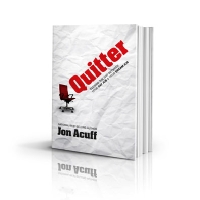
I’ve known about Jon Acuff for a while. I’ve checked out his Stuff Christians Like site several times and have chuckled at numerous articles (learned what a Jesus juke is, and found I’m not opposed to massages at church). He has a new book out called Quitter. I was curious, so I checked it out.
He pitches it with this statement:
Have you ever felt caught between the tension of a day job and a dream job? That gap between what you have to do and what you’d love to do?
(That’s where I’m living right now)
Jon offers practical advise in a very humorous package. It turns out Jon is a successful quitter. In two ways. First, he was good at hopping from job to job. The problem was they were lateral moves, not into his dream job. Finally, he was able to leave a good day job to a dream job. It’s from this experience that he shares.
He tells people not to quit too soon – to use the time with a regular job that pays the bills to prepare for the time they can do something different. He gives pointers on finding the dream you may have. A major point is to work hard (hustle) to make things happen. He had to learn to be happy with small successes before he hit the “big-time”.
He writes this book for a general audience, but he includes biblical principles without preaching or quoting chapter and verse. One idea I appreciated (and was challenged by) was his emphasis on not stealing from a current job while working toward a dream job. This seemed to echo the principle of being faithful with little, so that the Lord can give more. He doesn’t explain it like this, but the book has several points like this.
Jon came to fame as writing a satirical blog poking fun at the church. Thus, the book has plenty of humor. I appreciate his sense of humor and laughed at many points. Any satire/comedy won’t work for everyone, so I’m sure there will be those who don’t appreciate it. Those people probably don’t read this blog anyway.
If you’re toiling away in a job that doesn’t give the type of satisfaction you think it should, if you are wondering if there is a way out of the quagmire of the grind, then Quitter is a book that can give you insight and inspiration toward a better job. It won’t buff your resume or give you angelic revelation. I was bummed. But, it helped me realize I need to do more than complain, and it was an enjoyable read.
Oh, and I would recommend not leaving it out on your desk when reading it during lunch breaks – it might bring up some unwanted questions…
—
Anybody out there wrestling with this issue? Any experience with this idea of day job vs. dream job?
—
by Jason Joyner | Aug 10, 2011 | are you a quitter?, Blog, books, reviews, work
OK, the title of this post is lousy since my last rambling was whether I should quit blogging to focus on writing. It is lousy because it is misleading. And since I’m still here, I’m not quitting blogging.
But I want to be a Quitter.
I’ve known about Jon Acuff for a while. I’ve checked out his Stuff Christians Like site several times and have chuckled at numerous articles (learned what a Jesus juke is, and found I’m not opposed to massages at church). He has a new book out called Quitter. I was curious, so I checked it out.
He pitches it with this statement:
Have you ever felt caught between the tension of a day job and a dream job? That gap between what you have to do and what you’d love to do?
(That’s where I’m living right now)
Jon offers practical advise in a very humorous package. It turns out Jon is a successful quitter. In two ways. First, he was good at hopping from job to job. The problem was they were lateral moves, not into his dream job. Finally, he was able to leave a good day job to a dream job. It’s from this experience that he shares.
He tells people not to quit too soon – to use the time with a regular job that pays the bills to prepare for the time they can do something different. He gives pointers on finding the dream you may have. A major point is to work hard (hustle) to make things happen. He had to learn to be happy with small successes before he hit the “big-time”.
He writes this book for a general audience, but he includes biblical principles without preaching or quoting chapter and verse. One idea I appreciated (and was challenged by) was his emphasis on not stealing from a current job while working toward a dream job. This seemed to echo the principle of being faithful with little, so that the Lord can give more. He doesn’t explain it like this, but the book has several points like this.
Jon came to fame as writing a satirical blog poking fun at the church. Thus, the book has plenty of humor. I appreciate his sense of humor and laughed at many points. Any satire/comedy won’t work for everyone, so I’m sure there will be those who don’t appreciate it. Those people probably don’t read this blog anyway.
If you’re toiling away in a job that doesn’t give the type of satisfaction you think it should, if you are wondering if there is a way out of the quagmire of the grind, then Quitter is a book that can give you insight and inspiration toward a better job. It won’t buff your resume or give you angelic revelation. I was bummed. But, it helped me realize I need to do more than complain, and it was an enjoyable read.
Oh, and I would recommend not leaving it out on your desk when reading it during lunch breaks – it might bring up some unwanted questions…
—
Anybody out there wrestling with this issue? Any experience with this idea of day job vs. dream job?
—
by Jason Joyner | Aug 5, 2011 | Blog, blogging, priorities, take away his quotation key, writing craft
After a hectic week of family and vacation, here I am again.
*crickets*
In my deeply missed absence (snicker), I have been considering some priorities and some problems that go with this.
I am trying to become a writer. Some would say I am a writer, as I have maintained this blog on a fairly regular schedule for five years now. I am not sure about the designation, but maybe I’ll get there someday.
I’m also working a full-time job, trying to take care of my wife and four kids, and be a leader at church. In addition, I am also coaching soccer, keeping the house from being overrun by weeds, and avoiding stepping on two cats.
It leaves precious little time to write, and I struggle with the balance, as I know a gazillion other people out there do (I’m not trying to complain to gain sympathy, it’s just the facts, ma’am.)
I wonder sometimes if I should take the time I use in writing this blog and put it toward my main project. On the other hand, the writing gurus out there recommend having a “brand” or “platform” to help you get published. So if I abandon the blog, what happens to my platform, such as it is?
So in the irony of the internet age, I am writing a blog post to ask if it is better to divide time and continue blogging, or should I back off here to put more time into “productive” writing? I would also “ask” if I use “quotations” “excessively,” but I suspect I know “the” answer to that one.
Any thoughts, internet peeps? To blog or not to blog, that is the question?
—
by Jason Joyner | Aug 5, 2011 | Blog, blogging, priorities, take away his quotation key, writing craft
After a hectic week of family and vacation, here I am again.
*crickets*
In my deeply missed absence (snicker), I have been considering some priorities and some problems that go with this.
I am trying to become a writer. Some would say I am a writer, as I have maintained this blog on a fairly regular schedule for five years now. I am not sure about the designation, but maybe I’ll get there someday.
I’m also working a full-time job, trying to take care of my wife and four kids, and be a leader at church. In addition, I am also coaching soccer, keeping the house from being overrun by weeds, and avoiding stepping on two cats.
It leaves precious little time to write, and I struggle with the balance, as I know a gazillion other people out there do (I’m not trying to complain to gain sympathy, it’s just the facts, ma’am.)
I wonder sometimes if I should take the time I use in writing this blog and put it toward my main project. On the other hand, the writing gurus out there recommend having a “brand” or “platform” to help you get published. So if I abandon the blog, what happens to my platform, such as it is?
So in the irony of the internet age, I am writing a blog post to ask if it is better to divide time and continue blogging, or should I back off here to put more time into “productive” writing? I would also “ask” if I use “quotations” “excessively,” but I suspect I know “the” answer to that one.
Any thoughts, internet peeps? To blog or not to blog, that is the question?
—

by Jason Joyner | Jul 26, 2011 | Ashton Kutcher, Biblical worldview, Blog, DNA Foundation, human trafficking, Real Men don't buy girls, social justice, Village Voice
There is a concept in medicine called “herd immunity.”
If you are trying to immunize a population of 100 people against some nasty disease, you don’t have to reach everyone with the vaccine. That is hard to achieve. The concept of herd immunity means that if you manage to treat a certain number of the population – for argument’s sake we’ll say 80 – then the disease does not have enough places to live.
It survives by infecting a host and reproducing, passing itself to the next victim. If one person gets the disease, but doesn’t run into one of the other twenty unvaccinated people, then the disease can’t continue the process. It will die out in its host whether their immune system takes it out or the host expires. Now there is one less option for spread.
I think the concept of herd immunity is key when discussing sex trafficking and reducing demand.
I’ve spent the past couple of posts talking about the problem with freedom. (Day 1 and Day 2) To sum up: in Western culture and especially America, we like to say that people should have the freedom to do whatever they want, as long as it doesn’t hurt others. The problem becomes that we don’t always realize the unintended consequences of our actions, and more people are hurt than we realize.
We may enjoy our chocolate, but the cocoa beans sold to our favorite candy company finance a brutal regime. We may want a purebred puppy, but this supports puppy mills that churns out animals that are unhealthy and contributes to an overpopulation of pets.
Men may think they can look at pornography or solicit sex with a prostitute, and it is only their business. It’s not hurting anyone, and they have the right. Right?
My second post on this topic connects the increasing demand for porn and prostitution with the exploitation of children in the sex industry, as does this excellent Newsweek article. I started this whole series because of an article in the Village Voice trying to debunk statistics regarding human trafficking and attacking the campaign by Ashton and Demi’s DNA Foundation that wants to eradicate child sex exploitation and trafficking.
I’ve described the problem. The solution is always harder than identifying the problem.
Men, we have to realize that we are contributing to the exploitation and ruination of thousands of teen girls and vulnerable women. Our lust is providing a disease with plenty of hosts. The young and vulnerable women who are exploited by this industry are the victims, being ravaged by abuse, violence, and neglect. Whereas the DNA Foundation, IJM, Free the Slaves, and GEMS among others work to help these women, the Village Voice continues its defense of its adult services site Backpage.
As the Newsweek article details, the anonymity of the internet has created a huge increase in the demand for sexual buyers. Men think we can do what we want in private without hurting others. Whether downloading items off the net or arranging services at a clandestine location, it is a right. However, it feeds an industry that is devouring more and more of the “herd”.
If men would stand up and say “Real Men Don’t Buy Girls,” if men would realize that these activities are not harmless or private, but contribute to a larger problem, then perhaps we would start seeing some herd immunity develop. If enough men were vaccinated, as it were, then the demand would lessen and there wouldn’t be as much exploitation of the vulnerable.
I am not naive enough to believe we can eradicate this problem fully. I do believe we can work to educate men, the demand part of the supply and demand equation, that their actions are harmful and reduce the problem this way. Look at the major public education campaigns in the past:
- Telling people how HIV is transmitted and how to protect themselves.
- Reducing CFC’s to protect the ozone.
- Eliminating racist words from being used in mainstream culture.
- Abolishing the slave trade in the 1800’s through William Wilberforce and others.
The problem of men flouting their freedom and fueling a sick industry is real and worsening. People are waking up to this and speaking out, like at the DNA Foundation. The position of the Village Voice is wrong not because I am a religious fanatic or zealot. Their position is wrong because it hurts many people and deserves to be debated and debunked.
Community is not built by everyone having their own way. Community is built by people agreeing to limit themselves for the greater good, by seeing that limits are required to live together and provide true freedom for all.
—
