by Jason Joyner | Sep 18, 2011 | Blog, books, reviews, zombies as literature
Hungry for something different in fiction?
Ready to sink your teeth into some tasty reading?
Or perhaps you prefer brains…
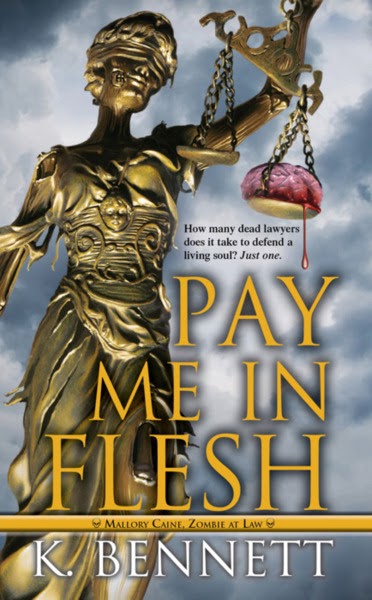
Pay Me In Flesh is the brainchild of one K. Bennett, a fertile mind who came up with a simple premise: what could be done that’s fresh in the zombie genre. Well, try this teaser on for size.
In L.A., practicing law can be hell. Especially if you’re dead.
In an increasingly hellacious L.A., zombie lawyer Mallory Caine defends a vampire hooker accused of the crime Mallory herself committed, even as a zombie-killer closes in and the love of her former life comes back as the Deputy DA she must oppose. And as Lucifer himself begins setting up L.A. as his headquarters for a new attack on heaven and earth, Mallory slowly discovers she may be the one who has to stop him.
This mass paperback book is packed with witty dialog, unforgettable characters, and an attorney with a bite. Mallory Caine is trying to find out who killed her and see if she can recover her soul. She hates to eat brains, but she’s doing what she must to survive. She’s not the normal lumbering, witless undead. Sure, she needs a little moisturizer and prefers educated brains (Harvard and Stanford go down much nicer than your drop-out), but she still sees a need for the innocent to get justice.
It is a fresh take on both the legal thriller and the zombie novel. The pace of the books keeps the reader lurching forward, and the city of Los Angeles becomes a character in the mood and setting of the novel.
I don’t want to give too much away. Suffice it to say, I think you won’t find a more original novel premise this year, and Pay Me In Flesh is a read that will have you laughing, drawn in, and hungry for more.
You may hear a rumor that K. Bennett shares a startling resemblance to James Scott Bell, but that’s a common point of confusion. Pay it no mind…
—

by Jason Joyner | Sep 14, 2011 | Biblical worldview, Blog, creativity, music
I’d like to introduce you to a lovely young woman from New Zealand.
Brooke Fraser.
You may not be familiar with her. She’s a singer/songwriter who is gaining an international reputation for her thoughtful, creative music. Hopefully you will become acquainted with her, because her songs are quite beautiful, with a unique sound and a touch of whimsy.
So why am I talking about a kiwi musician on a writing blog?
I follow the publishing industry in general, but the Christian fiction (CBA) arm specifically. The discussion of what is a Christian artist/writer/book is a never ending cycle of back and forth.
As for Brooke, she seems to have two distinct careers. She has released three albums for the mainstream, each progressively doing better first in New Zealand, then internationally. However, you may have heard her music on Sunday mornings as well. Her songs “Hosanna” and “Desert Song” are known worldwide in contemporary worship services, and she has done worship with Hillsongs United in Australia (sometimes as Brooke Ligertwood, her married name).
The interesting part is this dichotomy, where she is a successful artist to a mainstream audience, and can write and sing for a Christian audience without losing her other identity. When asked about “tension” with these two different worlds, she replies in an interview on an Australian website for Christian music:
You can’t put what God is doing on this earth into a box… it can’t be summarised into tidy categories. Whatever God is doing through my life, it’s not just about me. There’s a stirring happening in God’s Church, through the creative arts, creative ministries and other things too… and as time moves on we get closer and closer to Jesus coming back. God has a plan for the whole earth and it involves everyone one of us doing our part — it’s not necessarily going to look like something we can easily understand on the natural. I write worship songs that are for the building up of God’s people in the Church, and I love that because I’m able to express really clearly, and declare uncompromisingly my love for Jesus. But at the same time I recognise the importance of my other songs as being like parables… taking Church to people who would never walk into a church…
She says in the article that she doesn’t consider herself a CCM (Contemporary Christian Music) artist and actually resists it strongly because of concerns about “merchandising the gospel.” I know other artists won’t identify with CCM because of concerns of being pigeonholed and possibly reducing their audience, but I’ve never found a major artist who refuses identification with CCM due to such a conviction.
I like the part where she recognizes some of her songs can be directly worshipful, and others are like parables. One of my favorite bands is Switchfoot, and I think many of their songs work in this way.
Songwriting is a different skill than writing fiction, but I believe the ideas brought out by Brooke in her interview and career offer insight to those pursuing writing fiction and wondering where their work fits. I think a fiction example would be Ted Dekker, who is writing best-sellers in the thriller market, while still pursuing stories that speak more directly to a Christian aspect. His books certainly fit a parable.
I know there is a lot to discuss as far as marketing, reaching audiences, and message, but I think having the concept of parable versus being a direct expression of faith in fiction is one to consider.
For my writer friends – where do your stories fit? Parable or more directly speaking to issues of God and faith? What are books that have done both well?
—
Oh, and go check out Brooke’s website for some refreshing music!
—
by Jason Joyner | Sep 14, 2011 | Biblical worldview, Blog, creativity, music
I’d like to introduce you to a lovely young woman from New Zealand.
Brooke Fraser.
You may not be familiar with her. She’s a singer/songwriter who is gaining an international reputation for her thoughtful, creative music. Hopefully you will become acquainted with her, because her songs are quite beautiful, with a unique sound and a touch of whimsy.
So why am I talking about a kiwi musician on a writing blog?
I follow the publishing industry in general, but the Christian fiction (CBA) arm specifically. The discussion of what is a Christian artist/writer/book is a never ending cycle of back and forth.
As for Brooke, she seems to have two distinct careers. She has released three albums for the mainstream, each progressively doing better first in New Zealand, then internationally. However, you may have heard her music on Sunday mornings as well. Her songs “Hosanna” and “Desert Song” are known worldwide in contemporary worship services, and she has done worship with Hillsongs United in Australia (sometimes as Brooke Ligertwood, her married name).
The interesting part is this dichotomy, where she is a successful artist to a mainstream audience, and can write and sing for a Christian audience without losing her other identity. When asked about “tension” with these two different worlds, she replies in an interview on an Australian website for Christian music:
You can’t put what God is doing on this earth into a box… it can’t be summarised into tidy categories. Whatever God is doing through my life, it’s not just about me. There’s a stirring happening in God’s Church, through the creative arts, creative ministries and other things too… and as time moves on we get closer and closer to Jesus coming back. God has a plan for the whole earth and it involves everyone one of us doing our part — it’s not necessarily going to look like something we can easily understand on the natural. I write worship songs that are for the building up of God’s people in the Church, and I love that because I’m able to express really clearly, and declare uncompromisingly my love for Jesus. But at the same time I recognise the importance of my other songs as being like parables… taking Church to people who would never walk into a church…
She says in the article that she doesn’t consider herself a CCM (Contemporary Christian Music) artist and actually resists it strongly because of concerns about “merchandising the gospel.” I know other artists won’t identify with CCM because of concerns of being pigeonholed and possibly reducing their audience, but I’ve never found a major artist who refuses identification with CCM due to such a conviction.
I like the part where she recognizes some of her songs can be directly worshipful, and others are like parables. One of my favorite bands is Switchfoot, and I think many of their songs work in this way.
Songwriting is a different skill than writing fiction, but I believe the ideas brought out by Brooke in her interview and career offer insight to those pursuing writing fiction and wondering where their work fits. I think a fiction example would be Ted Dekker, who is writing best-sellers in the thriller market, while still pursuing stories that speak more directly to a Christian aspect. His books certainly fit a parable.
I know there is a lot to discuss as far as marketing, reaching audiences, and message, but I think having the concept of parable versus being a direct expression of faith in fiction is one to consider.
For my writer friends – where do your stories fit? Parable or more directly speaking to issues of God and faith? What are books that have done both well?
—
Oh, and go check out Brooke’s website for some refreshing music!
—
by Jason Joyner | Sep 8, 2011 | Blog, faith, musings
We all need reminders.
I just wish I didn’t require a spiritual head smack to get one.
I’ve been frustrated with some circumstances, mostly at work. My job has changed over time, and I don’t always feel like I’m making a difference or using my training or talents. I went to school for medicine – I seem to work in crisis management (and not the medical kind).
Add in some co-workers who make life difficult at times, and I have been longing to do something else lately. Life could be worse. I’m still employed, the job is not difficult, and I am liked by my management. Still, I get agitating at times, and I was focusing more on my circumstances that I didn’t like over anything else.
That’s when God spoke.
It went something like this: “Knock it off!”
I was reminded to focus on the One in control of the circumstances, over the circumstances themselves. He is in control – as always. I have seen His faithfulness too much to worry. I don’t remember this all the time, and I’m glad He doesn’t lose patience with me.
So if you hear me whining again, give me a kick in the shins please. God is too good for me to do that. I felt much better yesterday looking to Him instead of where I am. That’s how I’d prefer things.
What about you? Have you ever had one of those holy “thwacks”?
—
by Jason Joyner | Sep 8, 2011 | Blog, faith, musings
We all need reminders.
I just wish I didn’t require a spiritual head smack to get one.
I’ve been frustrated with some circumstances, mostly at work. My job has changed over time, and I don’t always feel like I’m making a difference or using my training or talents. I went to school for medicine – I seem to work in crisis management (and not the medical kind).
Add in some co-workers who make life difficult at times, and I have been longing to do something else lately. Life could be worse. I’m still employed, the job is not difficult, and I am liked by my management. Still, I get agitating at times, and I was focusing more on my circumstances that I didn’t like over anything else.
That’s when God spoke.
It went something like this: “Knock it off!”
I was reminded to focus on the One in control of the circumstances, over the circumstances themselves. He is in control – as always. I have seen His faithfulness too much to worry. I don’t remember this all the time, and I’m glad He doesn’t lose patience with me.
So if you hear me whining again, give me a kick in the shins please. God is too good for me to do that. I felt much better yesterday looking to Him instead of where I am. That’s how I’d prefer things.
What about you? Have you ever had one of those holy “thwacks”?
—
by Jason Joyner | Sep 1, 2011 | beauty, Biblical worldview, Blog, non-fiction
Thanks to Andrew Peterson on Twitter, I saw this wonderful post about “Proclaiming Truth Beautifully.” Trevin Wax takes a post from The Gospel-Driven Church as a launching point to discuss authors who speak truth, but don’t just do it from a point of giving information. They give it in an artful way that conveys God’s beauty not just via information, but through the language used as well.
Great post – highly recommended. As Trevin ends his post: “May God raise up a generation of writers who not only know the truth, but beckon others to swim in the depths of grace!”
—
by Jason Joyner | Sep 1, 2011 | beauty, Biblical worldview, Blog, non-fiction
Thanks to Andrew Peterson on Twitter, I saw this wonderful post about “Proclaiming Truth Beautifully.” Trevin Wax takes a post from The Gospel-Driven Church as a launching point to discuss authors who speak truth, but don’t just do it from a point of giving information. They give it in an artful way that conveys God’s beauty not just via information, but through the language used as well.
Great post – highly recommended. As Trevin ends his post: “May God raise up a generation of writers who not only know the truth, but beckon others to swim in the depths of grace!”
—
by Jason Joyner | Aug 24, 2011 | Blog, fiction, ResAlien, Residential Aliens, sci-fi, short stories, spacefaring nuns, writing craft
A long time ago, in a galaxy far far away…
Yeah, been there, done that.
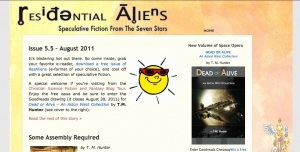
If you are looking for new and fresh science fiction and other speculative creative work, you need to check out
Residential Aliens – which is why we’re featuring it for the tour in August.
One thing I like about ResAliens is the fact that they look for fiction that accepts the spiritual as something acceptable to write about. Some may say that the “science” part of science fiction should preclude spirituality from being in the fiction. Doesn’t science disprove religion?
Mike Duran blogs frequently about the state of fiction, Christian fiction in particular, and speculative fiction. In his post “Why Science Fiction Embraces Religion… and Science Doesn’t,” he quotes another article that has this statement (regarding various sci-fi stories):
It’s never “Does this force actually exist?” It’s, “What do we call it?” Or “How do we treat it?” Or “How do we interact with it?” One of the many things that fascinates me about these stories is that the thing, whatever it is—a being, a force—always exists. Some choose to acknowledge it via gratitude, giving it a place of honor, organizing their lives around it and allowing it to feed them spiritually. Others simply use it as a thing, a tool, taking from it what they will when they will then calling it a day. But neither reaction negates the existence of the thing.
This seems to me to be what ResAliens is after – allowing authors a platform to use entertaining sci-fi stories to explore ideas that relate to spirituality.
I didn’t get a chance to exhaustively peruse the whole site, but I did find one story that stood out in quality of writing and depth of ideas.
“Of All Things, Seen And Unseen” is by the CSFF Tour’s own Fred Warren. I picked this story to read because of this connection, but my praise is earned through his quality of work only.
The story is based on a universe/concept from Robert and Karina Fabian, where there is an order called the “Rescue Sisters” that aids spacefaring travelers in distress. Fred’s story is his own other than being set in their universe.
Sister Claudia has always wanted to be a Rescue Sister. She is young and talented at what she does. However, a routine assist goes awry when she goes against orders, and she ends up losing part of her right arm. Her new disability limits her from the front line, and she struggles to find her place among the Sisters of Our Lady of the Rescue.
It is a straightfoward premise, but it is well-written and drew me into this setting. He paces the short story perfectly, putting us in Claudia’s dilemna, giving the background needed, and propelling the plot forward. To set up an appropriate conflict and resolution in a short story while having rounded characters and an intersting setting is a significant challenge, and Fred meets all of these points. More importantly, he paints a beautiful theme with Claudia’s adventure, and it is inspiring as well as entertaining.
I am intrigued enough with Residential Aliens that I will be watching for more from them, and will perhaps trying my own hand for a story there. I hope any fans of science fiction will check it out. My fellow tourmates have more on this, and Becky’s blog keeps track of all of these.
Happy spacefaring!
—
by Jason Joyner | Aug 24, 2011 | Blog, fiction, ResAlien, Residential Aliens, sci-fi, short stories, spacefaring nuns, writing craft
A long time ago, in a galaxy far far away…
Yeah, been there, done that.
If you are looking for new and fresh science fiction and other speculative creative work, you need to check out
Residential Aliens – which is why we’re featuring it for the tour in August.
One thing I like about ResAliens is the fact that they look for fiction that accepts the spiritual as something acceptable to write about. Some may say that the “science” part of science fiction should preclude spirituality from being in the fiction. Doesn’t science disprove religion?
Mike Duran blogs frequently about the state of fiction, Christian fiction in particular, and speculative fiction. In his post “Why Science Fiction Embraces Religion… and Science Doesn’t,” he quotes another article that has this statement (regarding various sci-fi stories):
It’s never “Does this force actually exist?” It’s, “What do we call it?” Or “How do we treat it?” Or “How do we interact with it?” One of the many things that fascinates me about these stories is that the thing, whatever it is—a being, a force—always exists. Some choose to acknowledge it via gratitude, giving it a place of honor, organizing their lives around it and allowing it to feed them spiritually. Others simply use it as a thing, a tool, taking from it what they will when they will then calling it a day. But neither reaction negates the existence of the thing.
This seems to me to be what ResAliens is after – allowing authors a platform to use entertaining sci-fi stories to explore ideas that relate to spirituality.
I didn’t get a chance to exhaustively peruse the whole site, but I did find one story that stood out in quality of writing and depth of ideas.
“Of All Things, Seen And Unseen” is by the CSFF Tour’s own Fred Warren. I picked this story to read because of this connection, but my praise is earned through his quality of work only.
The story is based on a universe/concept from Robert and Karina Fabian, where there is an order called the “Rescue Sisters” that aids spacefaring travelers in distress. Fred’s story is his own other than being set in their universe.
Sister Claudia has always wanted to be a Rescue Sister. She is young and talented at what she does. However, a routine assist goes awry when she goes against orders, and she ends up losing part of her right arm. Her new disability limits her from the front line, and she struggles to find her place among the Sisters of Our Lady of the Rescue.
It is a straightfoward premise, but it is well-written and drew me into this setting. He paces the short story perfectly, putting us in Claudia’s dilemna, giving the background needed, and propelling the plot forward. To set up an appropriate conflict and resolution in a short story while having rounded characters and an intersting setting is a significant challenge, and Fred meets all of these points. More importantly, he paints a beautiful theme with Claudia’s adventure, and it is inspiring as well as entertaining.
I am intrigued enough with Residential Aliens that I will be watching for more from them, and will perhaps trying my own hand for a story there. I hope any fans of science fiction will check it out. My fellow tourmates have more on this, and Becky’s blog keeps track of all of these.
Happy spacefaring!
—
by Jason Joyner | Aug 23, 2011 | Blog, ResAlien, Residential Aliens, sci-fi, space pirates, speculative fiction
Welcome back, science fiction fans!
The CSFF Tour is featuring Residential Aliens, the sci-fi zine that features online and print/e-reader science fiction/speculative fiction with a spiritual bent.
The site has an impressive amount of authors who have contributed. It isn’t such a niche product that there’s only five people who have written for it. I recognized a few names from our very own tour, which was way cool.
One thing you
should check out is the contest to win a
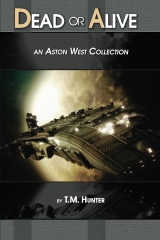
free copy of Dead or Alive – An Aston West Collection by T. M. Hunter. Mr. Hunter has written a few novels and several short stories featuring Aston West, a good old fashioned kind of space pirate – the kind that gets into trouble and scrapes to get out of a mess. Fan of Han Solo and Mal Reynolds? Aston fits the bill. I read his short story
“Some Assembly Required” featured on the front of the ResAliens page this month. It was entertaining and drew me into Aston’s world without boring me with backstory. It was a thoughtful story contemplating the thought of free will and individual freedom, without being preachy. The ending felt a little rushed – maybe he had a word count he had to hit – but it was a worthwhile read.
In honor of the CSFF Tour, ResAliens is offering a free download of a recent issue for e-reader format. Check
this link to try it out for your e-reader of choice.
Finally for today, if you like to write sci-fi or other speculative fiction, ResAliens takes submissions. They pay a small stipend, but it is a publishing credit nonetheless. Checking out the submission page today, out of 32 submissions, only 8 were accepted. They are discriminating.
Tomorrow I want to discuss a story I read on ResAliens that was particularly well done, as an example of the quality that smaller outfits like ResAliens can highlight.
As always, if you’re looking for more, go to Becky Miller’s website where she keeps track of all the posts for the tour. Don’t be blazing by in light speed – stick around and enjoy!
—
