by Jason Joyner | May 3, 2007 | Blog, books, CFBA, fiction
Some books just have a great concept that makes a reader wonder, “Why didn’t anyone do this before. It’s fabulous!”
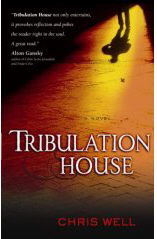
Today’s book featured in the CFBA is one such book. Tribulation House, the third book by novelist and magazine editor (and all around busy guy) Chris Well. I had an interview with him that I posted here. Today I want to review TH.
Here’s the back cover blurb:
IT’S NOT THE END OF THE WORLD—WHICH COULD BE A PROBLEM…
Mark Hogan has it all. The job. The family. A position on the board at church. All he’s missing is a boat. Not just any boat—a 2008 Bayliner 192.
When Reverend Daniel Glory announces that the Rapture is taking
place on October 17 at 5:51 am, Hogan realizes his boat–buying days are numbered. So he does what any man in his situation would do—he borrows a load of money from the mob. Not that there’s any risk involved: After all, when the Rapture comes, Hogan will be long gone. The mob will never find him. But when Jesus fails to come back on schedule, Mark Hogan finds the mob is in no mood to discuss the finer points of end–times theology…
You’re smiling already, right?
 Honestly, this could be a real one-note story that falls flat. Thankfully, Chris is a talented writer who keeps things moving by incorporating the story into the world of the Kansas City mob and the law enforcement trying to take them down – the world that was the setting for his previous two novels, Forgiving Solomon Long and Deliver Us from Evelyn. We get to follow along with lovable, comic book geek detective Charlie Pasch as he finds his groove. Detective Tom Griggs has some confrontation to do and a major surprise. Other new characters are brought in to fill out this tale, all connected to our Rapture-watching protaganist in various ways.
This is Well’s most blatantly Christian novel, and pokes some good natured fun at those who stand around watching the sky for Jesus’ return a little too much, while giving us a nudge in the right direction. Humor is hard to pull off, but he does it with just the right touch of speaking to serious issues as well.
One of his strengths is his unique characterizations. He seems to be trying to restrain himself as far as number of characters, but still does a great job of making each distinctive. For the most part he makes the mobsters believable creatures without making them vulgar (although one gangster calling another “dum-dum” didn’t ring true). The main character gets so self-focused you want to smack him, but that is probably how he should be treated!
The ending will leave you wanting more, I can promise you that! (Grrr…) Again, Chris has a quick pace that carries you through the book, an enjoyable read that tickles your funny bone and pricks your conscience.
by Jason Joyner | May 3, 2007 | Blog, books, CFBA, fiction
Some books just have a great concept that makes a reader wonder, “Why didn’t anyone do this before. It’s fabulous!”
Today’s book featured in the CFBA is one such book. Tribulation House, the third book by novelist and magazine editor (and all around busy guy) Chris Well. I had an interview with him that I posted here. Today I want to review TH.
Here’s the back cover blurb:
IT’S NOT THE END OF THE WORLD—WHICH COULD BE A PROBLEM…
Mark Hogan has it all. The job. The family. A position on the board at church. All he’s missing is a boat. Not just any boat—a 2008 Bayliner 192.
When Reverend Daniel Glory announces that the Rapture is taking
place on October 17 at 5:51 am, Hogan realizes his boat–buying days are numbered. So he does what any man in his situation would do—he borrows a load of money from the mob. Not that there’s any risk involved: After all, when the Rapture comes, Hogan will be long gone. The mob will never find him. But when Jesus fails to come back on schedule, Mark Hogan finds the mob is in no mood to discuss the finer points of end–times theology…
You’re smiling already, right?
Honestly, this could be a real one-note story that falls flat. Thankfully, Chris is a talented writer who keeps things moving by incorporating the story into the world of the Kansas City mob and the law enforcement trying to take them down – the world that was the setting for his previous two novels, Forgiving Solomon Long and Deliver Us from Evelyn. We get to follow along with lovable, comic book geek detective Charlie Pasch as he finds his groove. Detective Tom Griggs has some confrontation to do and a major surprise. Other new characters are brought in to fill out this tale, all connected to our Rapture-watching protaganist in various ways.
This is Well’s most blatantly Christian novel, and pokes some good natured fun at those who stand around watching the sky for Jesus’ return a little too much, while giving us a nudge in the right direction. Humor is hard to pull off, but he does it with just the right touch of speaking to serious issues as well.
One of his strengths is his unique characterizations. He seems to be trying to restrain himself as far as number of characters, but still does a great job of making each distinctive. For the most part he makes the mobsters believable creatures without making them vulgar (although one gangster calling another “dum-dum” didn’t ring true). The main character gets so self-focused you want to smack him, but that is probably how he should be treated!
The ending will leave you wanting more, I can promise you that! (Grrr…) Again, Chris has a quick pace that carries you through the book, an enjoyable read that tickles your funny bone and pricks your conscience.
by Jason Joyner | May 3, 2007 | Biblical worldview, Blog, books, fiction, music
On Monday I introduced the idea of the Christian Marketplace, dealing with art and entertainment, specifically the pop culture elements of fiction and music. What was my prompting?
During the last fantasy blog tour, I came across this review of The Light of Eidon by Karen Hancock. Here’s a snippet:
It was a little hard to follow, but had a decent plot and likeable characters. About halfway through, my opinion of this book steeply declined. The reason? A bedroom scene. Ms. Hancock aptly incorporates a highly descriptive scene where the main character sleeps (and does a few other things!) with the girl he likes. I’m usually not one to be revolted by mild sensuality; the only other book I’ve stopped reading because of the sex was a Robert Ludlum novel. This, however, was just too much. I would expect this from a secular novel, but it was disappointing in a book that billed itself as “Christian.”
First of all, the reviewer is wrong, or at best misleading. The scene was written in such a way that the reader knew what the character was dealing with, without crossing into unneeded voyeurism.
However, this example highlights a problem with the Christian marketplace – the reviewer felt a need to make a judgment on an artistic work based off of spiritual standards. Actually, that’s something we all do to a degree: do we accept the worldview and particulars presented to us in entertainment? Many Christians like the movie Braveheart due to the ideas of sacrifice and freedom, but some couldn’t (legitimately) get past the nudity or violence.
But Christian artists live under a pressure to create with expectations. I don’t mind that this reviewer felt the scene in Eidon was too much for her sensibilities. I don’t think it was even wrong to put a review saying, “Hey, y’all might want to watch out for [x] or [y].” I get disconcerted when she challenges an author’s walk with God and quotes Philippians 4:8 as a condemnation for those who might actually read (uh-oh) and enjoy (gasp!) this book.
Don’t get me wrong. We need to judge what we can handle or not handle. And we shouldn’t end up with reading Christian “porn” or erotica. But can you see the dilemma for the Christian artist? You may write a scene that you think is needed for the artistic integrity of the story, and that you’ve done it in a creative way that is within reason. All it takes is one offended individual to post something on Amazon, and you lose potential readers.
This problem doesn’t just exist for Christian fiction. Infuze has an interview with 18 year old singer/songwriter Bethany Dillon. I really haven’t listened to her, but have heard good reviews about her work. In the interview she has to defend herself from writing love songs!
I’m very much a girl and feel that the feminine soul is made to be completely distracted by a story like that. I mean, probably the masculine soul as well, but seeing as how I only have my experience… [Laughs] But I think that you’re so right. There are things – not as an accusation – but I think the American church especially seeks to control and pacify so many things that it shuts down anything that could be slightly messy or that could have a couple mistakes. We have an obsession with very controllable things.
Where do we go from here? I’ll take this up soon (either before or after a review of Chris Well’s new book).
by Jason Joyner | May 3, 2007 | Biblical worldview, Blog, books, fiction, music
On Monday I introduced the idea of the Christian Marketplace, dealing with art and entertainment, specifically the pop culture elements of fiction and music. What was my prompting?
During the last fantasy blog tour, I came across this review of The Light of Eidon by Karen Hancock. Here’s a snippet:
It was a little hard to follow, but had a decent plot and likeable characters. About halfway through, my opinion of this book steeply declined. The reason? A bedroom scene. Ms. Hancock aptly incorporates a highly descriptive scene where the main character sleeps (and does a few other things!) with the girl he likes. I’m usually not one to be revolted by mild sensuality; the only other book I’ve stopped reading because of the sex was a Robert Ludlum novel. This, however, was just too much. I would expect this from a secular novel, but it was disappointing in a book that billed itself as “Christian.”
First of all, the reviewer is wrong, or at best misleading. The scene was written in such a way that the reader knew what the character was dealing with, without crossing into unneeded voyeurism.
However, this example highlights a problem with the Christian marketplace – the reviewer felt a need to make a judgment on an artistic work based off of spiritual standards. Actually, that’s something we all do to a degree: do we accept the worldview and particulars presented to us in entertainment? Many Christians like the movie Braveheart due to the ideas of sacrifice and freedom, but some couldn’t (legitimately) get past the nudity or violence.
But Christian artists live under a pressure to create with expectations. I don’t mind that this reviewer felt the scene in Eidon was too much for her sensibilities. I don’t think it was even wrong to put a review saying, “Hey, y’all might want to watch out for [x] or [y].” I get disconcerted when she challenges an author’s walk with God and quotes Philippians 4:8 as a condemnation for those who might actually read (uh-oh) and enjoy (gasp!) this book.
Don’t get me wrong. We need to judge what we can handle or not handle. And we shouldn’t end up with reading Christian “porn” or erotica. But can you see the dilemma for the Christian artist? You may write a scene that you think is needed for the artistic integrity of the story, and that you’ve done it in a creative way that is within reason. All it takes is one offended individual to post something on Amazon, and you lose potential readers.
This problem doesn’t just exist for Christian fiction. Infuze has an interview with 18 year old singer/songwriter Bethany Dillon. I really haven’t listened to her, but have heard good reviews about her work. In the interview she has to defend herself from writing love songs!
I’m very much a girl and feel that the feminine soul is made to be completely distracted by a story like that. I mean, probably the masculine soul as well, but seeing as how I only have my experience… [Laughs] But I think that you’re so right. There are things – not as an accusation – but I think the American church especially seeks to control and pacify so many things that it shuts down anything that could be slightly messy or that could have a couple mistakes. We have an obsession with very controllable things.
Where do we go from here? I’ll take this up soon (either before or after a review of Chris Well’s new book).
by Jason Joyner | May 1, 2007 | Blog, CFBA, comics, fiction
This week’s CFBA tour is for Tribulation House by the talented Chris Well. I’ve known about Chris before his first novel, Tribulation House later this week, as well as continuing my discussion about the Christian Marketplace.
1. You write “laugh-out loud crime thrillers” with gangsters and some rougher elements. How do you deal with the CBA market informal guidelines and realistically portraying these characters? Any problems with dealing with the issue of hardened criminals and the use of cursing?
Frankly, I don’t *want* to write novels that are vulgar: There is enough ugliness in the world without my *adding* to it. Yes, my stories do involve a lot of broken people making a lot of bad choices (and doing a lot of bad things), but a creative writer should be able to leave something to the imagination of the reader.
2. TH is your 3rd book. Was it harder to write your first novel, or iskeeping up with deadlines with your full-time work more challenging?
Each novel is a new journey of discovery for me — so while some elements of the process are getting easier, each time out I am still trying to stretch for something new. If I’m not flying without a net, I am certainly playing close to the edge of the net. As such, I hope each novel is a better read — and I hope I never become so complacent that I stop pushing to that “next place.” And, yes, it is tough doing all this with a day job. But I like what I do, so that is not going to change anytime soon. (Plug: Sign up at http://www.myccm.org!/)
3. What process do you use to keep a handle on your characters and their always interesting quirks?
With these Harvest House books, I got locked into an “ensemble” format, the hardest part of which is coordinating all the different crazy people doing all the separate stories (that still have to criss-cross throughout the novel).
So … it usually means I have to stop every 1/3 of the way or so and re-read everything before I go on. And do a lot of revising as I go. And then eventually make some sort of chart or graph or timeline, and then I write all these bullet points down on index cards …
Let’s just say that at some crucial juncture with all three –FORGIVING SOLOMON LONG, DELIVER US FROM EVELYN, and TRIBULATION HOUSE– there was finally a point where I literally sat down with scissors and a printout and cut up all the different scenes and made everything fit in the right order. So I think you can understand why the projects I’m working on right now are limited to the single-person perspective. (And they are going WAY faster!)
4. What is your favorite comic book story arc? What is Charlie’s?
Wow. Um, off the top of my head: “Unthinkable,” FANTASTIC FOUR Vol. 3, #67-71 (2003), by Mark Waid and Mike Wieringo. Plus KINGDOM COME, ASTONISHING X-MEN, WATCHMEN, COMMON GROUNDS, THE DARK KNIGHT RETURNS, BATMAN: STRANGE APPARITIONS, X-MEN: DAYS OF FUTURE PAST …
I like a lot of comics. (And so does Charlie.)
by Jason Joyner | May 1, 2007 | Blog, CFBA, comics, fiction
This week’s CFBA tour is for Tribulation House by the talented Chris Well. I’ve known about Chris before his first novel, Tribulation House later this week, as well as continuing my discussion about the Christian Marketplace.
1. You write “laugh-out loud crime thrillers” with gangsters and some rougher elements. How do you deal with the CBA market informal guidelines and realistically portraying these characters? Any problems with dealing with the issue of hardened criminals and the use of cursing?
Frankly, I don’t *want* to write novels that are vulgar: There is enough ugliness in the world without my *adding* to it. Yes, my stories do involve a lot of broken people making a lot of bad choices (and doing a lot of bad things), but a creative writer should be able to leave something to the imagination of the reader.
2. TH is your 3rd book. Was it harder to write your first novel, or iskeeping up with deadlines with your full-time work more challenging?
Each novel is a new journey of discovery for me — so while some elements of the process are getting easier, each time out I am still trying to stretch for something new. If I’m not flying without a net, I am certainly playing close to the edge of the net. As such, I hope each novel is a better read — and I hope I never become so complacent that I stop pushing to that “next place.” And, yes, it is tough doing all this with a day job. But I like what I do, so that is not going to change anytime soon. (Plug: Sign up at http://www.myccm.org!/)
3. What process do you use to keep a handle on your characters and their always interesting quirks?
With these Harvest House books, I got locked into an “ensemble” format, the hardest part of which is coordinating all the different crazy people doing all the separate stories (that still have to criss-cross throughout the novel).
So … it usually means I have to stop every 1/3 of the way or so and re-read everything before I go on. And do a lot of revising as I go. And then eventually make some sort of chart or graph or timeline, and then I write all these bullet points down on index cards …
Let’s just say that at some crucial juncture with all three –FORGIVING SOLOMON LONG, DELIVER US FROM EVELYN, and TRIBULATION HOUSE– there was finally a point where I literally sat down with scissors and a printout and cut up all the different scenes and made everything fit in the right order. So I think you can understand why the projects I’m working on right now are limited to the single-person perspective. (And they are going WAY faster!)
4. What is your favorite comic book story arc? What is Charlie’s?
Wow. Um, off the top of my head: “Unthinkable,” FANTASTIC FOUR Vol. 3, #67-71 (2003), by Mark Waid and Mike Wieringo. Plus KINGDOM COME, ASTONISHING X-MEN, WATCHMEN, COMMON GROUNDS, THE DARK KNIGHT RETURNS, BATMAN: STRANGE APPARITIONS, X-MEN: DAYS OF FUTURE PAST …
I like a lot of comics. (And so does Charlie.)
by Jason Joyner | Apr 30, 2007 | Biblical worldview, Blog, fiction, writing craft
Ever since the last fantasy book tour, I’ve been thinking about the paradox that is the “Christian Marketplace”. Never heard of it? Me neither – in that form. There’s no real term for what I’m going to discuss today. In Christian fiction we use the term “CBA” which stands for the Christian Booksellers Association. This is the group that is the gatekeeper for Christian publishing, as opposed to the American Booksellers Association (ABA), which is where secular publishing occurs (although the ABA is not exclusive against Christian authors, while the CBA is). The problem with my discussion today is that it goes beyond fiction, thus the term Christian Marketplace.
To me the Christian Marketplace is the sub-culture that has been created for (mainly) Evangelical Christians in entertainment – encompassing music and fiction primarily, but can include movies, TV, video games, and other mediums. I don’t know the history on how Christian fiction became segregated, but I have some understanding regarding contemporary Christian music (CCM).
CCM came about after the Jesus People movement in the late 60’s/early 70’s, when hippies were getting saved, and doing what came natural to them: playing rock and roll. At first artists were on record labels along with regular artists of the day. Unfortunately, these pioneers were in between a rock and a hard place (no pun intended). Their music was too religious for the mainstream labels, but too loud for the general church audience (and a lot different from the black gospel/southern gospel forms that had been around all along).
Specific music labels were created to be a showcase for these artists. Soon there was Christian radio to play this music, with Christian rock festivals, and Christian music magazines. Soon it became a self-sustaining phenomenon, and it the process turned the word Christian into an artificial genre description rather than what the intent of the term may be.
This has been going on for thirty some-odd years for CCM. Like I said, I don’t know when Christian fiction became a sub-category (after C.S. Lewis’ time, thankfully). But I do know it was mainly known for prarie romances and historical fiction until Frank Peretti came along in the late 80’s with his This Present Darkness and subsequent books. This has triggered a slowly burgeoning fiction landscape that has a pretty diverse selection of books at this point.
Whoa, didn’t know this would start with a history lesson. Where was I going with this? Oh yeah, the CSFF tour from 2 weeks ago. What really got me thinking was a review of Karen Hancock’s book The Light of Eidon on Amazon that was mentioned on Rebecca Grabill’s blog. Check out that review, and I’ll discuss what instigated all of this tomorrow.
by Jason Joyner | Apr 30, 2007 | Biblical worldview, Blog, fiction, writing craft
Ever since the last fantasy book tour, I’ve been thinking about the paradox that is the “Christian Marketplace”. Never heard of it? Me neither – in that form. There’s no real term for what I’m going to discuss today. In Christian fiction we use the term “CBA” which stands for the Christian Booksellers Association. This is the group that is the gatekeeper for Christian publishing, as opposed to the American Booksellers Association (ABA), which is where secular publishing occurs (although the ABA is not exclusive against Christian authors, while the CBA is). The problem with my discussion today is that it goes beyond fiction, thus the term Christian Marketplace.
To me the Christian Marketplace is the sub-culture that has been created for (mainly) Evangelical Christians in entertainment – encompassing music and fiction primarily, but can include movies, TV, video games, and other mediums. I don’t know the history on how Christian fiction became segregated, but I have some understanding regarding contemporary Christian music (CCM).
CCM came about after the Jesus People movement in the late 60’s/early 70’s, when hippies were getting saved, and doing what came natural to them: playing rock and roll. At first artists were on record labels along with regular artists of the day. Unfortunately, these pioneers were in between a rock and a hard place (no pun intended). Their music was too religious for the mainstream labels, but too loud for the general church audience (and a lot different from the black gospel/southern gospel forms that had been around all along).
Specific music labels were created to be a showcase for these artists. Soon there was Christian radio to play this music, with Christian rock festivals, and Christian music magazines. Soon it became a self-sustaining phenomenon, and it the process turned the word Christian into an artificial genre description rather than what the intent of the term may be.
This has been going on for thirty some-odd years for CCM. Like I said, I don’t know when Christian fiction became a sub-category (after C.S. Lewis’ time, thankfully). But I do know it was mainly known for prarie romances and historical fiction until Frank Peretti came along in the late 80’s with his This Present Darkness and subsequent books. This has triggered a slowly burgeoning fiction landscape that has a pretty diverse selection of books at this point.
Whoa, didn’t know this would start with a history lesson. Where was I going with this? Oh yeah, the CSFF tour from 2 weeks ago. What really got me thinking was a review of Karen Hancock’s book The Light of Eidon on Amazon that was mentioned on Rebecca Grabill’s blog. Check out that review, and I’ll discuss what instigated all of this tomorrow.
by Jason Joyner | Apr 30, 2007 | Blog, goofiness
A fun little diversion that I picked up on thanks to Mir. Actually somewhat accurate concerning me. I haven’t done blog tagging before, but I would love to see what Becky, Chris, and Matt came up with on this – consider yourselves tagged!
by Jason Joyner | Apr 30, 2007 | Blog, goofiness
A fun little diversion that I picked up on thanks to Mir. Actually somewhat accurate concerning me. I haven’t done blog tagging before, but I would love to see what Becky, Chris, and Matt came up with on this – consider yourselves tagged!
