by Jason Joyner | Jul 29, 2010 | Blog, books, boundaries, CBA, christian fiction
Let me say up front that I am merely an observer of the CBA market for Christian fiction. I review CBA books for a couple of blog tours. I have interacted with various authors at various stages in their careers. I have been quoted for an endorsement – a highlight!
Still, there are some interesting rumblings in the CBA world.
Last week I wondered out loud if some authors shouldn’t consider ABA publishing (basically secular publishers or the general market) for their works, as what they write chafes some readers of CBA fiction.
More importantly by far, novelist Eric Wilson wrote a post entitled, “Is It Time for Christian Fiction to Die?” This has already generated some light, as in the discussion on his Facebook page, and some heat as well. Mike Duran talked about this article at Novel Journey on Monday (see the comments for a little of the heat). Mike references Eric’s article again for another post discussing a related issue, “Should Profit Be the Bottom Line for Christian Fiction?” where he asks about the conflict of “ministry” vs. “business.”
Of course, there was more discussion out there. My friend Becky Miller initially had a little different take (okay, she calls it a rant). Then she referenced another thoughtful post by novelist Mike Dellosso, who talks about an author following their calling wherever it leads, and trying to avoid some things that can bring frustration (like tracking Amazon sales numbers). What Mike talks about is fleshed out well in Jeff Gerke’s Tips for Writers (see #93), where he stresses understanding whether a writer is called to write for the Christian/CBA market for encouragement/challenge/entertainment, or whether they have a missionary vision to reach non-believers (who usually won’t be found in a Christian bookstore buying CBA books).
My friend Nicole at Into the Fire will be posting some responses from CBA industry insiders starting next week, and she has already posted some starting thoughts here and here (the last one is about the heartache caused by our culture’s use/misuse of sex – very poignant).
Finally, after inundating you with links, Tim George (a frequent reviewer of CBA fiction) chimes in with thoughts similar to Mike, but are worth checking out on their own.
Can I sum up what I’ve seen so far?
- Eric seems to be crying out for the CBA “industry” (actually a conglomeration of publishers, agents, booksellers, etc and not one specific agency) to be more open for those called to reach the culture for Jesus, rather than singing to the choir.
- He sees a place for “clean” or “safe” fiction for entertainment/encouragement, but doesn’t want it to the exclusion of fiction that reaches out and perhaps crosses some boundaries.
- He feels there has been a “narrowing” of what is acceptable in CBA fiction lately.
- There is a running debate behind the scenes on whether CBA fiction should be more “edgy.” The definition of edgy is nebulous. Some mean it as detailing real-to-life scenarios. Others ask for CBA fiction to be less restrictive of certain taboos such as non-erotic descriptions of sex or some cussing.
- CBA is a business responding to supply and demand, and the main buyers of the product tend to be middle-aged women who prefer romances, historicals, and/or Amish fiction. The market for suspense, horror, sci-fi, fantasy, etc is a lot smaller.
- Also, the market has been affected by the recession and the new trends of ebooks.
- Responses to Eric’s post range from hearty amens, people who accuse him of not being a “team player” or taking a “parting shot” as he leaves the industry, to others who think CBA is broadening, just not as fast as some may want.
- Some like the dialogue and think of the sparks created as “iron sharpening iron,” while others suggest we’ve been down this road before.
- Finally, people are wondering if there isn’t room for both “edgy” and “safe” in the CBA. (If we could define what is edgy…)
Like I said above, I’m an observer, albiet an interested party as I am slowly working on a book that, for now, I feel should go into the CBA realm, but it may be a hard sell due to its content (the characters confront sex slavery in Thailand). I will be watching this discussion intrigued. Nicole’s posts for next week I will certainly not miss.
This is only a small part of the discussion. I’d be interested in other thoughtful posts if anyone knows of any out there. I am excited for dialogue, but we shouldn’t forget strategic prayer that those in leadership/influence for CBA publishing as well as the authors know God’s calling for them, and pursue it to the best of their abilities, and that He will open doors for it to be used. I am all for being strategic in trying to positively affect culture, but I also realize where my Source comes from. Blessings, all!
—
by Jason Joyner | Jul 21, 2010 | Blog, CSFF, dragons, fantasy
Hey there true believers! (Sorry, thinking about Stan Lee for some reason…)
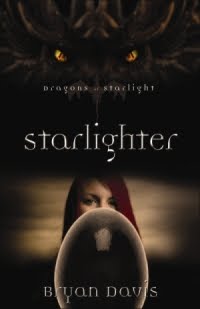
The Christian Sci-fi and Fantasy blog tour is off to a great start featuring Starlighter, the latest book from Bryan Davis. I’m not off to a great start, as I kinda missed out on this one. I didn’t realize it was the first in a series, so I wouldn’t have been behind from the get-go. Oh well, summer is busy.
The cover there looks great, and I’d still like to point you to some further sources of info if you’re into dragons that kidnaps humans, or heroes named “Jason” (great choice there Bryan!)
Specifically, check out Fred Warren’s excellent (as usual) posts discussing the book: Day 1, Day 2, Day 3.
You can find Bryan’s blog and website at the links.
Below are the links to the others in the tour. For direct links to posts, go to Becky Miller’s blog for the most up-to-date postings.
Brandon Barr
Beckie Burnham
Jeff Chapman
R. L. Copple
CSFF Blog Tour
Stacey Dale
D. G. D. Davidson
Jeff Draper
April Erwin
Andrea Graham
Tori Greene
Nikole Hahn
Ryan Heart
Becky Jesse
Cris Jesse
Julie
Carol Keen
Krystine Kercher
Dawn King
Leighton
Jane Maritz
Rebecca LuElla Miller
John W. Otte
Donita K. Paul
Crista Richey
SarahFlan
Chawna Schroeder
Rachel Starr Thomson
Steve Trower
Fred Warren
Dona Watson
Phyllis Wheeler
Jill Williamson
KM Wilsher
—
by Jason Joyner | Jul 21, 2010 | Blog, CSFF, dragons, fantasy
Hey there true believers! (Sorry, thinking about Stan Lee for some reason…)
The Christian Sci-fi and Fantasy blog tour is off to a great start featuring Starlighter, the latest book from Bryan Davis. I’m not off to a great start, as I kinda missed out on this one. I didn’t realize it was the first in a series, so I wouldn’t have been behind from the get-go. Oh well, summer is busy.
The cover there looks great, and I’d still like to point you to some further sources of info if you’re into dragons that kidnaps humans, or heroes named “Jason” (great choice there Bryan!)
Specifically, check out Fred Warren’s excellent (as usual) posts discussing the book: Day 1, Day 2, Day 3.
You can find Bryan’s blog and website at the links.
Below are the links to the others in the tour. For direct links to posts, go to Becky Miller’s blog for the most up-to-date postings.
Brandon Barr
Beckie Burnham
Jeff Chapman
R. L. Copple
CSFF Blog Tour
Stacey Dale
D. G. D. Davidson
Jeff Draper
April Erwin
Andrea Graham
Tori Greene
Nikole Hahn
Ryan Heart
Becky Jesse
Cris Jesse
Julie
Carol Keen
Krystine Kercher
Dawn King
Leighton
Jane Maritz
Rebecca LuElla Miller
John W. Otte
Donita K. Paul
Crista Richey
SarahFlan
Chawna Schroeder
Rachel Starr Thomson
Steve Trower
Fred Warren
Dona Watson
Phyllis Wheeler
Jill Williamson
KM Wilsher
—
by Jason Joyner | Jul 19, 2010 | Blog, CBA, christian fiction, speculative fiction
Yes! Another blog discussion on the boundaries of Christian/CBA fiction!
Seriously, this has been dragged around the virtual block more than a few times. If you’re late to the party and want to catch up, I hinted about this subject, then talked some more about it, based off the new Robin Parrish novel Nightmare, and intertwined this subject with a review of a new, gritty police procedural Back on Murder by J. Mark Bertrand.
Nightmare is a book best categorized by the term “paranormal suspense,” while Back on Murder is a very real-to-life crime novel. How do these two relate with each other and pushing the boundaries of Christian fiction?
The CBA market (fiction carried by Christian book stores for the uninitiated) is a growth market for the publishing industry. In the 1990’s it was mostly historical fiction, romance, or historical romance, with the Left Behind series thrown in for good measure. Oh, and this guy Frank Peretti had some spiritual warfare novels that were a hit.
In the 2000’s CBA has grown to hold pretty much any genre of fiction: suspense, science fiction, fantasy, chick-lit, horror, romance, contemporary, historical. For some reason Amish stories are a particular favorite, but we won’t go there today. Still, there are questions about what gets published under the (nebulous) banner of CBA fiction. Nightmare got great reviews from a recent blog tour for its writing and suspense, but a few people questioned the subject of ghosts and how they were handled in the book (I’m currently reading Nightmare and will go in detail on it later).
How far will CBA fiction go? I think it will go where the market allows, being a business. I don’t expect it to cross into subjects like erotica or new age topics that don’t measure up with the Bible. Slowly publishers seem okay with the “grey areas”, but this market still skews mostly to the Evangelical Christian reader.
Does Nightmare push the boundaries? Perhaps. Should it? Maybe. Maybe it should be published in the “secular” book market (the ABA is the umbrella term for publishers who don’t produce books with mainly Christian book stores in mind. Basically most of the publishing world…). I think Robin’s book could go either way. Maybe its place is in a larger field to play in. Then again, there is a much bigger market out there, and perhaps it would not find an audience with so many choices available (not for poor quality, but sheer numbers of other books).
How about Back on Murder as far as pushing boundaries? My friend Nicole didn’t think it did. Maybe not in a controversial way. I feel like it does in the fact that I haven’t read a book like it in CBA fiction (then again, straight crime/police procedural novels aren’t my first choice). I think it could stand in ABA fiction as it is – especially compared to the garbage that James Patterson writes.
Some books are more or less written for the CBA market. There is a valid place for this market, but it has struggled with self-imposed rules and (mostly undeserved) image problems of being inferior quality. I see certain writers with their feet firmly planted in the CBA market. Others like Tosca Lee, Gina Holmes, Mark Bertrand, and Tim Downs have written stories that could crossover, in my opinion, quite easily to the ABA market, due to the quality and way that faith is handled. Why do we not see these more prominently in Barnes & Noble, Borders, etc?
CBA fiction is growing in a good way, and I’m happy to see it. I just wonder if some books still aren’t better off in a different pond…
What say you?
—
by Jason Joyner | Jul 19, 2010 | Blog, CBA, christian fiction, speculative fiction
Yes! Another blog discussion on the boundaries of Christian/CBA fiction!
Seriously, this has been dragged around the virtual block more than a few times. If you’re late to the party and want to catch up, I hinted about this subject, then talked some more about it, based off the new Robin Parrish novel Nightmare, and intertwined this subject with a review of a new, gritty police procedural Back on Murder by J. Mark Bertrand.
Nightmare is a book best categorized by the term “paranormal suspense,” while Back on Murder is a very real-to-life crime novel. How do these two relate with each other and pushing the boundaries of Christian fiction?
The CBA market (fiction carried by Christian book stores for the uninitiated) is a growth market for the publishing industry. In the 1990’s it was mostly historical fiction, romance, or historical romance, with the Left Behind series thrown in for good measure. Oh, and this guy Frank Peretti had some spiritual warfare novels that were a hit.
In the 2000’s CBA has grown to hold pretty much any genre of fiction: suspense, science fiction, fantasy, chick-lit, horror, romance, contemporary, historical. For some reason Amish stories are a particular favorite, but we won’t go there today. Still, there are questions about what gets published under the (nebulous) banner of CBA fiction. Nightmare got great reviews from a recent blog tour for its writing and suspense, but a few people questioned the subject of ghosts and how they were handled in the book (I’m currently reading Nightmare and will go in detail on it later).
How far will CBA fiction go? I think it will go where the market allows, being a business. I don’t expect it to cross into subjects like erotica or new age topics that don’t measure up with the Bible. Slowly publishers seem okay with the “grey areas”, but this market still skews mostly to the Evangelical Christian reader.
Does Nightmare push the boundaries? Perhaps. Should it? Maybe. Maybe it should be published in the “secular” book market (the ABA is the umbrella term for publishers who don’t produce books with mainly Christian book stores in mind. Basically most of the publishing world…). I think Robin’s book could go either way. Maybe its place is in a larger field to play in. Then again, there is a much bigger market out there, and perhaps it would not find an audience with so many choices available (not for poor quality, but sheer numbers of other books).
How about Back on Murder as far as pushing boundaries? My friend Nicole didn’t think it did. Maybe not in a controversial way. I feel like it does in the fact that I haven’t read a book like it in CBA fiction (then again, straight crime/police procedural novels aren’t my first choice). I think it could stand in ABA fiction as it is – especially compared to the garbage that James Patterson writes.
Some books are more or less written for the CBA market. There is a valid place for this market, but it has struggled with self-imposed rules and (mostly undeserved) image problems of being inferior quality. I see certain writers with their feet firmly planted in the CBA market. Others like Tosca Lee, Gina Holmes, Mark Bertrand, and Tim Downs have written stories that could crossover, in my opinion, quite easily to the ABA market, due to the quality and way that faith is handled. Why do we not see these more prominently in Barnes & Noble, Borders, etc?
CBA fiction is growing in a good way, and I’m happy to see it. I just wonder if some books still aren’t better off in a different pond…
What say you?
—
