by Jason Joyner | Aug 3, 2010 | Blog, Christianity, hypocrisy, post-modern
As I was riding along with a close friend in a certain Utah metropolitan area, he vented that he didn’t like living in the center of Mormondom, because he felt Mormons were all hypocrites.
An epiphany hit me right then: he was right. Mormons are hypocrites.
So was he. So am I.
We are all hypocrites.
I’m writing this today because I see so many people nowadays, ESPECIALLY on the internet, decry Christians as hypocrites. It is getting popular to bash Christianity, not just from the “liberal elite” and “Hollywood elite” but your run-of-the-mill Joe on the street. Just last week, author Anne Rice “quit” Christianity. She says she is still centered on Christ, but she couldn’t be associated with such close-minded people anymore. The comments on the articles regarding this had savage disregard for Christians by the majority of the posters.
This is what I wish my Twitter response would have been:
Pot: @Kettle: ur black! LOL!!11!
OK, before this gets too weird, what do I mean with all of this?
Truly, we are all hypocrites. The etymology of the word comes from the Greek, and it meant a stage actor or pretender. It of course stems from the
root word hypocrisy, which also talks about playing a part.
This is very apt. We all play games and act the part. None of us are immune from putting on a phony front. None of us are consistent in how we act in comparison to what we believe. We may say cheating is wrong, but we find a way to work around the system into our favor. Sounds like cheating to me. A popular saying is “it was only a little white lie.” And once my wife was only a little pregnant.

My friend felt Mormons weren’t consistent with their standards of belief. Sure. I know numerous LDS adherents who practice very high benchmarks, but I must confess, none of them are perfect at holding up their standards. Neither am I. Of course it looks worse when religious people don’t follow their creeds exactly, because religion is about holding a standard. It especially looks bad when an Evangelical pastor decries homosexuality but ends up with a male escort, or a Christian politician who ran on “family values” is sneaking off for an affair.
“Do not judge, or you too will be judged. For in the same way you judge others, you will be judged, and with the measure you use, it will be measured to you.
Why do you look at the speck of sawdust in your brother’s eye and pay no attention to the plank in your own eye? How can you say to your brother, ‘Let me take the speck out of your eye,’ when all the time there is a plank in your own eye? You hypocrite, first take the plank out of your own eye, and then you will see clearly to remove the speck from your brother’s eye.”
Christians need to keep this in mind, so we walk with the humility needed to realize we are going to screw up. However, the point for us is, we have an avenue for redemption. We have a way to better ourselves. We won’t be perfect until we meet Jesus, but we have a hope. We have no excuse when we show hypocrisy. It is a sin, and there are consequences. I know I want to get better. For me it is the process of sanctification – meaning that the Holy Spirit is working in me to slowly change me. I wish it were faster, but the limitation comes from me alone.
For those who want to keep accusing Christians of hypocrisy – ya got us. But note the words from the apostle Matthew above – “for in the same way YOU JUDGE OTHERS, you will be judged.” You’ve been warned. If you accuse people of hypocrisy, you might want to look in the mirror first. We’re not alone.
—
by Jason Joyner | Aug 3, 2010 | Blog, Christianity, hypocrisy, post-modern
As I was riding along with a close friend in a certain Utah metropolitan area, he vented that he didn’t like living in the center of Mormondom, because he felt Mormons were all hypocrites.
An epiphany hit me right then: he was right. Mormons are hypocrites.
So was he. So am I.
We are all hypocrites.
I’m writing this today because I see so many people nowadays, ESPECIALLY on the internet, decry Christians as hypocrites. It is getting popular to bash Christianity, not just from the “liberal elite” and “Hollywood elite” but your run-of-the-mill Joe on the street. Just last week, author Anne Rice “quit” Christianity. She says she is still centered on Christ, but she couldn’t be associated with such close-minded people anymore. The comments on the articles regarding this had savage disregard for Christians by the majority of the posters.
This is what I wish my Twitter response would have been:
Pot: @Kettle: ur black! LOL!!11!
OK, before this gets too weird, what do I mean with all of this?
Truly, we are all hypocrites. The etymology of the word comes from the Greek, and it meant a stage actor or pretender. It of course stems from the
root word hypocrisy, which also talks about playing a part.
This is very apt. We all play games and act the part. None of us are immune from putting on a phony front. None of us are consistent in how we act in comparison to what we believe. We may say cheating is wrong, but we find a way to work around the system into our favor. Sounds like cheating to me. A popular saying is “it was only a little white lie.” And once my wife was only a little pregnant.
My friend felt Mormons weren’t consistent with their standards of belief. Sure. I know numerous LDS adherents who practice very high benchmarks, but I must confess, none of them are perfect at holding up their standards. Neither am I. Of course it looks worse when religious people don’t follow their creeds exactly, because religion is about holding a standard. It especially looks bad when an Evangelical pastor decries homosexuality but ends up with a male escort, or a Christian politician who ran on “family values” is sneaking off for an affair.
“Do not judge, or you too will be judged. For in the same way you judge others, you will be judged, and with the measure you use, it will be measured to you.
Why do you look at the speck of sawdust in your brother’s eye and pay no attention to the plank in your own eye? How can you say to your brother, ‘Let me take the speck out of your eye,’ when all the time there is a plank in your own eye? You hypocrite, first take the plank out of your own eye, and then you will see clearly to remove the speck from your brother’s eye.”
Christians need to keep this in mind, so we walk with the humility needed to realize we are going to screw up. However, the point for us is, we have an avenue for redemption. We have a way to better ourselves. We won’t be perfect until we meet Jesus, but we have a hope. We have no excuse when we show hypocrisy. It is a sin, and there are consequences. I know I want to get better. For me it is the process of sanctification – meaning that the Holy Spirit is working in me to slowly change me. I wish it were faster, but the limitation comes from me alone.
For those who want to keep accusing Christians of hypocrisy – ya got us. But note the words from the apostle Matthew above – “for in the same way YOU JUDGE OTHERS, you will be judged.” You’ve been warned. If you accuse people of hypocrisy, you might want to look in the mirror first. We’re not alone.
—

by Jason Joyner | Jul 31, 2010 | Blog, CFBA, fiction
This week, the
Christian Fiction Blog Alliance
is introducing
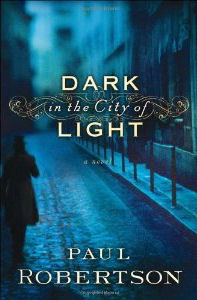
Dark In The City Of Light Bethany House (July 1, 2010)
by Paul Robertson
ABOUT THE AUTHOR:
Paul Robertson is a computer programming consultant, part-time high-school math and science teacher, and the author of The Heir. He is also a former Christian bookstore owner (for 15 years), who lives with his family in Blacksburg, Virginia.
ABOUT THE BOOK
What Evil Haunts the Shadows of 1870s Paris?
Baron Ferdinand Harsanyi — After his wife’s mysterious death, this Austrian attaché holds control over mines whose coveted ore could turn the tide of war.
Therese Harsanyi — Swept up in new romance and the spectacle of Paris, the Baron’s daughter is blind to the dangers stalking her family and the city she loves.
Rudolph Harsanyi — Unsure whom to trust, the Baron’s son’s grief over his mother’s death twists into growing anger and a desire to break free.
As France and Prussia plunge toward war, one family is caught in a web of deceit, political intrigue, and murder that threatens to tear them apart.
If you would like to read the first chapter of Dark In The City Of Light, go HERE.
by Jason Joyner | Jul 31, 2010 | Blog, CFBA, fiction
This week, the
Christian Fiction Blog Alliance
is introducing
Dark In The City Of Light Bethany House (July 1, 2010)
by Paul Robertson
ABOUT THE AUTHOR:
Paul Robertson is a computer programming consultant, part-time high-school math and science teacher, and the author of The Heir. He is also a former Christian bookstore owner (for 15 years), who lives with his family in Blacksburg, Virginia.
ABOUT THE BOOK
What Evil Haunts the Shadows of 1870s Paris?
Baron Ferdinand Harsanyi — After his wife’s mysterious death, this Austrian attaché holds control over mines whose coveted ore could turn the tide of war.
Therese Harsanyi — Swept up in new romance and the spectacle of Paris, the Baron’s daughter is blind to the dangers stalking her family and the city she loves.
Rudolph Harsanyi — Unsure whom to trust, the Baron’s son’s grief over his mother’s death twists into growing anger and a desire to break free.
As France and Prussia plunge toward war, one family is caught in a web of deceit, political intrigue, and murder that threatens to tear them apart.
If you would like to read the first chapter of Dark In The City Of Light, go HERE.
by Jason Joyner | Jul 29, 2010 | Blog, books, boundaries, CBA, christian fiction
Let me say up front that I am merely an observer of the CBA market for Christian fiction. I review CBA books for a couple of blog tours. I have interacted with various authors at various stages in their careers. I have been quoted for an endorsement – a highlight!
Still, there are some interesting rumblings in the CBA world.
Last week I wondered out loud if some authors shouldn’t consider ABA publishing (basically secular publishers or the general market) for their works, as what they write chafes some readers of CBA fiction.
More importantly by far, novelist Eric Wilson wrote a post entitled, “Is It Time for Christian Fiction to Die?” This has already generated some light, as in the discussion on his Facebook page, and some heat as well. Mike Duran talked about this article at Novel Journey on Monday (see the comments for a little of the heat). Mike references Eric’s article again for another post discussing a related issue, “Should Profit Be the Bottom Line for Christian Fiction?” where he asks about the conflict of “ministry” vs. “business.”
Of course, there was more discussion out there. My friend Becky Miller initially had a little different take (okay, she calls it a rant). Then she referenced another thoughtful post by novelist Mike Dellosso, who talks about an author following their calling wherever it leads, and trying to avoid some things that can bring frustration (like tracking Amazon sales numbers). What Mike talks about is fleshed out well in Jeff Gerke’s Tips for Writers (see #93), where he stresses understanding whether a writer is called to write for the Christian/CBA market for encouragement/challenge/entertainment, or whether they have a missionary vision to reach non-believers (who usually won’t be found in a Christian bookstore buying CBA books).
My friend Nicole at Into the Fire will be posting some responses from CBA industry insiders starting next week, and she has already posted some starting thoughts here and here (the last one is about the heartache caused by our culture’s use/misuse of sex – very poignant).
Finally, after inundating you with links, Tim George (a frequent reviewer of CBA fiction) chimes in with thoughts similar to Mike, but are worth checking out on their own.
Can I sum up what I’ve seen so far?
- Eric seems to be crying out for the CBA “industry” (actually a conglomeration of publishers, agents, booksellers, etc and not one specific agency) to be more open for those called to reach the culture for Jesus, rather than singing to the choir.
- He sees a place for “clean” or “safe” fiction for entertainment/encouragement, but doesn’t want it to the exclusion of fiction that reaches out and perhaps crosses some boundaries.
- He feels there has been a “narrowing” of what is acceptable in CBA fiction lately.
- There is a running debate behind the scenes on whether CBA fiction should be more “edgy.” The definition of edgy is nebulous. Some mean it as detailing real-to-life scenarios. Others ask for CBA fiction to be less restrictive of certain taboos such as non-erotic descriptions of sex or some cussing.
- CBA is a business responding to supply and demand, and the main buyers of the product tend to be middle-aged women who prefer romances, historicals, and/or Amish fiction. The market for suspense, horror, sci-fi, fantasy, etc is a lot smaller.
- Also, the market has been affected by the recession and the new trends of ebooks.
- Responses to Eric’s post range from hearty amens, people who accuse him of not being a “team player” or taking a “parting shot” as he leaves the industry, to others who think CBA is broadening, just not as fast as some may want.
- Some like the dialogue and think of the sparks created as “iron sharpening iron,” while others suggest we’ve been down this road before.
- Finally, people are wondering if there isn’t room for both “edgy” and “safe” in the CBA. (If we could define what is edgy…)
Like I said above, I’m an observer, albiet an interested party as I am slowly working on a book that, for now, I feel should go into the CBA realm, but it may be a hard sell due to its content (the characters confront sex slavery in Thailand). I will be watching this discussion intrigued. Nicole’s posts for next week I will certainly not miss.
This is only a small part of the discussion. I’d be interested in other thoughtful posts if anyone knows of any out there. I am excited for dialogue, but we shouldn’t forget strategic prayer that those in leadership/influence for CBA publishing as well as the authors know God’s calling for them, and pursue it to the best of their abilities, and that He will open doors for it to be used. I am all for being strategic in trying to positively affect culture, but I also realize where my Source comes from. Blessings, all!
—