by Jason Joyner | Feb 25, 2011 | arts, Blog, creativity, fiction, kernels that aren't popcorn, writing craft
Most people don’t wonder about a body floating in the water.
Unless you are a writer.
|
| The body is just to the left |
That’s the image that came to me many moons ago. I saw in my mind a body floating in the water, in the ocean to be specific. Then I saw a boat run into the body, and the shocked fisherman frightened by his find.
Did I mention the man was from Thailand?
This is how my work in progress started. An image in my head. I started asking questions. Who is this person? Why are they dead? How did they end up here?
I learned that it was Travis Dawson, and that he was a missionary in Thailand. I discovered he had a sister named Jenna who was in medical school. She was a spunky younger sister type, and she didn’t take too well to the news of her brother’s death. She was impulsive enough to jet off to Asia to try and figure out what happened. Oh, and her slacker friend Derek Stephens, who had done a backpacking trip in Thailand previously, decided to tag along.
I don’t know how other authors come up with their story ideas, but I usually have images that beg to be explored. Yesterday for the end of the CSFF Tour I talked about whether a writer has their basic thrust as message-first vs. art-first. The responses from Dona, Becky, and Morgan made me think about my own process.
You have the set-up for my novel above. I thought for a time that there would be an aspect of spiritual warfare between the Christian missionaries and the strongholds in SE Asia. That didn’t fit the story though. Then I saw how Jenna had been estranged from her faith due to family trials when younger, and she would be challenged in them while dealing with something bigger than she could handle in Thailand. Travis uncovered a human trafficking ring, and this lead to his death and would be a major challenge to Jenna.
It seems that I had the story kernel that wanted told at first, and the themes of faith and human trafficking came out from there. I believe there’s always a theme when we write – otherwise what is the point of writing? Even if a writer says there’s not, there is something of their worldview getting in there.
Both the message and art pathways are valid ways to begin, and both have their strengths and weaknesses. Like I said in yesterday’s post, a message driven book must have a strong story and sparkling writing to not be bogged down by the message. It may not appear organic. But the “let’s see where the muse takes us” approach can end up with a wishy-washy theme that doesn’t give a work of fiction the power only a story can bring.
What say my writing buddies? What is your approach, and why do you do it that way?
—
by Jason Joyner | Feb 25, 2011 | arts, Blog, creativity, fiction, kernels that aren't popcorn, writing craft
Most people don’t wonder about a body floating in the water.
Unless you are a writer.
|
| The body is just to the left |
That’s the image that came to me many moons ago. I saw in my mind a body floating in the water, in the ocean to be specific. Then I saw a boat run into the body, and the shocked fisherman frightened by his find.
Did I mention the man was from Thailand?
This is how my work in progress started. An image in my head. I started asking questions. Who is this person? Why are they dead? How did they end up here?
I learned that it was Travis Dawson, and that he was a missionary in Thailand. I discovered he had a sister named Jenna who was in medical school. She was a spunky younger sister type, and she didn’t take too well to the news of her brother’s death. She was impulsive enough to jet off to Asia to try and figure out what happened. Oh, and her slacker friend Derek Stephens, who had done a backpacking trip in Thailand previously, decided to tag along.
I don’t know how other authors come up with their story ideas, but I usually have images that beg to be explored. Yesterday for the end of the CSFF Tour I talked about whether a writer has their basic thrust as message-first vs. art-first. The responses from Dona, Becky, and Morgan made me think about my own process.
You have the set-up for my novel above. I thought for a time that there would be an aspect of spiritual warfare between the Christian missionaries and the strongholds in SE Asia. That didn’t fit the story though. Then I saw how Jenna had been estranged from her faith due to family trials when younger, and she would be challenged in them while dealing with something bigger than she could handle in Thailand. Travis uncovered a human trafficking ring, and this lead to his death and would be a major challenge to Jenna.
It seems that I had the story kernel that wanted told at first, and the themes of faith and human trafficking came out from there. I believe there’s always a theme when we write – otherwise what is the point of writing? Even if a writer says there’s not, there is something of their worldview getting in there.
Both the message and art pathways are valid ways to begin, and both have their strengths and weaknesses. Like I said in yesterday’s post, a message driven book must have a strong story and sparkling writing to not be bogged down by the message. It may not appear organic. But the “let’s see where the muse takes us” approach can end up with a wishy-washy theme that doesn’t give a work of fiction the power only a story can bring.
What say my writing buddies? What is your approach, and why do you do it that way?
—
by Jason Joyner | Feb 23, 2011 | Blog, CSFF, fiction, Mike Duran, writing craft
Okay, so I’m in the minority in this one.
Yesterday I gave my review for The God Haters by Bill Myers, in which I didn’t have a great opinion of the book. It seems that a majority of the CSFF Tour is enjoying the book. There are a few that REALLY love it, a wider majority that likes it a lot, and there are a couple of stragglers with me saying “Meh.” (I love to say “meh” even when I don’t have a reason for it. Meh.)
That’s alright. Everyone’s going to have an opinion, and I admire what he tried to do, and he’s published way more books than me, so take this for what it is.
I followed The God Hater by reading The Resurrection, the debut novel from internet buddy Mike Duran, and the subject of next month’s CSFF tour. The back-to-back reading was an interesting contrast to me.
Bill Myers said in a Q&A in the back of his book that he likes to have a significant quiet time each morning with God to seek ideas about his writing. He seems to write books directed at opening Biblical truth in new ways via fiction. This is my take at least, and I consider it an admirable goal.
Mike Duran has been blogging for quite a while at Decompose, and he is a strong proponent of the “art first/message second” school of thought.
I mentioned yesterday that there seems to be two philosophical schools in CBA fiction (and in Christian entertainment in general, i.e. film, music, etc.). One way has a message or theme that they craft a story around, and the other comes at a story open-ended, and in the creative process the theme works out from that. Of course these are simplifications and these type of things never fit neatly into a specific box.
I would say that there was a different tactic taken by the two authors I’m contrasting. My perception is that Myers was inspired to write a story that presented God’s logic as a creator through an imperfect vessel, an atheist professor, and had to weave around that framework. I would guess Duran asked a question: What would happen if a resurrection happened today, and wrote his story exploring that a little more open-ended.
I’m not trying to say one way or the other is right. I would say that there are potential pitfalls with both approaches. Myers’ book is a loose allegory, and to try and work a Biblical tale into modern fiction is a difficult task. An author really has to nail it to make it work. I think Francine Rivers has done that very well with her book Redeeming Love, which is mentioned often as a great book that is a Western take on the story of Hosea. I’ve also seen books written closer to Duran’s work that don’t make a strong statement one way or the other on its premise, which is a let down to a reader.
I remember a heated debate in the mid 90’s (yes, way back then) when the editor of CCM Magazine slammed the latest album by Carman, considering it to be inferior art and only a vehicle for preaching a message with a beat associated with it. The two sat down in an interview and cleared the air, but it was an interesting event nonetheless. I do side more with the editor, because I think Christian art (whether fiction, music, or film) gets a bad rap when we produce weak product but sell it because it is “ministry.” Brandilyn Collins is a prolific suspense author that has been praised by Publishers Weekly. She has said many times her job is to entertain first, but as a Christian author she gets to put in truth to varying degrees based off what fits the story, which only adds depth to what she is doing. I like this statement, and I would say it sums up my philosophy well.
I can’t really state where either author comes from. I can only give my opinion and relate it to the idea of how do we write. The two different novels served as a jumping off point is all. Obviously The God Haters didn’t work for me, but I also don’t like those that get sanctimonious about a work of art being inferior. Give your opinion, but don’t take it personal. I’ve seen other Christians get on their high horse over such issues. I wish Bill Myers much success in his writing career. But I won’t be passing it on to other readers either.
If you’re curious about The Resurrection, I’ll have a review of it for my next post. If you want to see what the other tourmates are saying about The God Maker, check out Becky Miller’s blog, as she keeps track of all the posts for the tour. The CSFF tour is always enjoyable in seeing the varying opinions, so check them out!
—
by Jason Joyner | Feb 23, 2011 | Blog, CSFF, fiction, Mike Duran, writing craft
Okay, so I’m in the minority in this one.
Yesterday I gave my review for The God Haters by Bill Myers, in which I didn’t have a great opinion of the book. It seems that a majority of the CSFF Tour is enjoying the book. There are a few that REALLY love it, a wider majority that likes it a lot, and there are a couple of stragglers with me saying “Meh.” (I love to say “meh” even when I don’t have a reason for it. Meh.)
That’s alright. Everyone’s going to have an opinion, and I admire what he tried to do, and he’s published way more books than me, so take this for what it is.
I followed The God Hater by reading The Resurrection, the debut novel from internet buddy Mike Duran, and the subject of next month’s CSFF tour. The back-to-back reading was an interesting contrast to me.
Bill Myers said in a Q&A in the back of his book that he likes to have a significant quiet time each morning with God to seek ideas about his writing. He seems to write books directed at opening Biblical truth in new ways via fiction. This is my take at least, and I consider it an admirable goal.
Mike Duran has been blogging for quite a while at Decompose, and he is a strong proponent of the “art first/message second” school of thought.
I mentioned yesterday that there seems to be two philosophical schools in CBA fiction (and in Christian entertainment in general, i.e. film, music, etc.). One way has a message or theme that they craft a story around, and the other comes at a story open-ended, and in the creative process the theme works out from that. Of course these are simplifications and these type of things never fit neatly into a specific box.
I would say that there was a different tactic taken by the two authors I’m contrasting. My perception is that Myers was inspired to write a story that presented God’s logic as a creator through an imperfect vessel, an atheist professor, and had to weave around that framework. I would guess Duran asked a question: What would happen if a resurrection happened today, and wrote his story exploring that a little more open-ended.
I’m not trying to say one way or the other is right. I would say that there are potential pitfalls with both approaches. Myers’ book is a loose allegory, and to try and work a Biblical tale into modern fiction is a difficult task. An author really has to nail it to make it work. I think Francine Rivers has done that very well with her book Redeeming Love, which is mentioned often as a great book that is a Western take on the story of Hosea. I’ve also seen books written closer to Duran’s work that don’t make a strong statement one way or the other on its premise, which is a let down to a reader.
I remember a heated debate in the mid 90’s (yes, way back then) when the editor of CCM Magazine slammed the latest album by Carman, considering it to be inferior art and only a vehicle for preaching a message with a beat associated with it. The two sat down in an interview and cleared the air, but it was an interesting event nonetheless. I do side more with the editor, because I think Christian art (whether fiction, music, or film) gets a bad rap when we produce weak product but sell it because it is “ministry.” Brandilyn Collins is a prolific suspense author that has been praised by Publishers Weekly. She has said many times her job is to entertain first, but as a Christian author she gets to put in truth to varying degrees based off what fits the story, which only adds depth to what she is doing. I like this statement, and I would say it sums up my philosophy well.
I can’t really state where either author comes from. I can only give my opinion and relate it to the idea of how do we write. The two different novels served as a jumping off point is all. Obviously The God Haters didn’t work for me, but I also don’t like those that get sanctimonious about a work of art being inferior. Give your opinion, but don’t take it personal. I’ve seen other Christians get on their high horse over such issues. I wish Bill Myers much success in his writing career. But I won’t be passing it on to other readers either.
If you’re curious about The Resurrection, I’ll have a review of it for my next post. If you want to see what the other tourmates are saying about The God Maker, check out Becky Miller’s blog, as she keeps track of all the posts for the tour. The CSFF tour is always enjoyable in seeing the varying opinions, so check them out!
—

by Jason Joyner | Feb 23, 2011 | Blog, CFBA, christian fiction, guys can enjoy romance too, Jenny B Jones is funny
We interrupt this blog tour with another blog tour.
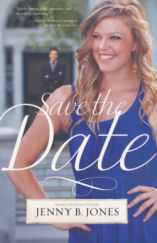
I also review for the Christian Fiction Blog Alliance. This week they are featuring Jenny B. Jones and her latest book, Save the Date.
I hope it has been established now that I’m a dude. I like explosions, football collisions, and helicopter/car chases. All three mashed together is awesome sauce.
I found out about Jenny B. Jones through Chip MacGregor, fiction agent extraordinare who is enough of a dude that he wears a kilt. In public. He highlighted her as a very funny writer. So I decided to get her book to review, likely having my wife read it.
*Ahem*
I didn’t get it in time to finish it for the tour, but I am laughing out loud while reading it. And it is a ROMANCE. Now, it does have an ex-football player, which gives it a few manly points, but note that he is an EX. I don’t care. I’m enjoying her writing style, the prose, the witty sense of humor. And I really want to see what happens to Lucy and her girls’ home.
*Sniff*
Take that for what it’s worth, and check out her book.
—
(Time to blow something up…virtually…like in a video game…hey, don’t look at me like I’m weird…)
—