
by Jason Joyner | Apr 4, 2012 | Blog, humor, what are you laughing at, writing craft, Writing Wednesday
|
| LOLZ! So funny! |
Last week I was part of a blog tour for the book Night of the Living Dead Christian by Matt Mikalatos. One aspect of the book that was always brought out was its humor in the way it dealt with serious issues of faith. Matt’s sense of humor didn’t resonate with everyone, but everyone recognized it was a valid device to get points across.
So how do we make others laugh in our writing?
I am writing a suspense. I hope it is suspenseful. I hope it keeps people turning the pages. But I also want there to be some laughs in the midst of it. Not only do I enjoy that type of writing, I think it helps control the mood. If a writer can disarm a reader with a laugh at one point and hit them with a gut punch of drama later on, the reader has more of an emotional ride from it.
I’m the type that really enjoys laughing. My favorite writing combines suspense, good characterization, and a sense of humor. Some of my favorite authors are James Scott Bell, Tim Downs, and Rene Gutteridge. They are all known for a clever or witty voice. Even in a serious book, they have moments where the reader is disarmed by a funny comment or piece of dialogue. Heck,
I read the romance Save the Date by Jenny B. Jones because of her humerous writing.
I try to do that in my own writing. I like to find the little surprise or twist that catches people off guard. I don’t know if it is working, but if it makes me smile after reading it over again, my feeling is it has potential.
What do you think? Do you try for humor in your writing? If so, how do you go about putting the funny in there?
—
by Jason Joyner | Apr 2, 2012 | believe, Blog, human trafficking, Mission Monday
- Men trapped on fishing boats forced to work, by not being allowed to go on shore.
- Whole families conscripted into working for brick-making plants in India due to a past debt.
- Women used to due hair extensions in Western beauty parlors.
- A children’s choir from Africa touring a rich country to accolades, only to find the performers are paid next to nothing.
- Young girls tricked into prostitution by the false promise of good jobs in Eastern Europe or Southeast Asia or in the United States.
Last week I posted the video of the song 27 Million, sung by Matt Redman and LZ7 to bring awareness to all of the people worldwide in slave conditions. The idea is that there are 27 million people in slavery around the globe RIGHT NOW.
All of the above scenarios are part of modern day slavery and human trafficking. It happens in rich and poor countries, in the West, East, North, and South. Some critics say abolition groups focus on sexual aspects of trafficking. It just happens to be very common, but there are many variations of slavery altogether.
Is it unreasonable to think we can change this?
If African slavery was ended in Europe and the United States, why can’t it happen now?
If a committed group continues to cry for justice, will the cry be heard?
I believe in a God of power and justice, so yes, I believe it will be heard. I believe it can happen.
Don’t forget. Read and get educated.
There will be more…
—
by Jason Joyner | Apr 2, 2012 | believe, Blog, human trafficking, Mission Monday
- Men trapped on fishing boats forced to work, by not being allowed to go on shore.
- Whole families conscripted into working for brick-making plants in India due to a past debt.
- Women used to due hair extensions in Western beauty parlors.
- A children’s choir from Africa touring a rich country to accolades, only to find the performers are paid next to nothing.
- Young girls tricked into prostitution by the false promise of good jobs in Eastern Europe or Southeast Asia or in the United States.
Last week I posted the video of the song 27 Million, sung by Matt Redman and LZ7 to bring awareness to all of the people worldwide in slave conditions. The idea is that there are 27 million people in slavery around the globe RIGHT NOW.
All of the above scenarios are part of modern day slavery and human trafficking. It happens in rich and poor countries, in the West, East, North, and South. Some critics say abolition groups focus on sexual aspects of trafficking. It just happens to be very common, but there are many variations of slavery altogether.
Is it unreasonable to think we can change this?
If African slavery was ended in Europe and the United States, why can’t it happen now?
If a committed group continues to cry for justice, will the cry be heard?
I believe in a God of power and justice, so yes, I believe it will be heard. I believe it can happen.
Don’t forget. Read and get educated.
There will be more…
—
by Jason Joyner | Mar 28, 2012 | Blog, books, CSFF, Matt Mikalatos, monsters, Night of the Living Dead Christian, Writing Wednesday, zombies
We’ve come to the darkness.
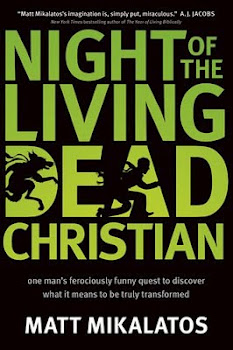
I’ve challenged people if they have what it takes to read Night Of The Living Dead Christian. I’ve explained the book (as best I can) and asked people to share their inner monster. What is the point of all of this monster lore, and how does it relate to Christianity?
Matt Mikalatos wrote a funny book to make the medicine go down better. He’s a smiling Mary Poppins. But we need to see that as Christians, we often have a monster form that we take.
What is a monster? Generally it is anything outside of the norm for a creature. Whether it is a cross of types (like a werewolf or Sasquatch) or a perverted form (vampire, zombie), it is a recognition that something is not right. The person is not who they seem to be.
How many Christians can attest to the fact they don’t live up to the transformed life that we are supposed to have in Christ? How many of us are comfortable admitting that even though we have the Holy Spirit dwelling with us, we wrest control and try to make our lives something of our own?
We live in delusion if we don’t see that there are monsters we each battle.
Matt manages to use this as an allegory on helping us to find transformation in the blood of Jesus, and nothing more.
The zombies in his story are Christians who have mindlessly followed a leader and have no life in themselves, thus becoming undead. The vampire Lara was wounded by her ex-husband so much that she had to start stealing life from others to feel alive. Luther the werewolf realizes that he has an animal side with lusts of the flesh he can’t control. One of the tragic moments in the book is when Luther dresses up very nice and meets with his estranged wife. Only his tail is showing, his teeth are long, and his fur has to be brushed. He tries to accept the wolf part of him and dress it up as acceptable.
Needless to say, it doesn’t go well.
How many of us have tried to deny the animal desires, only to fail when we are tired, stressed, or challenged by a strong temptation?
Thus the monster motif is a perfect vehicle for challenging Church, Christians, and ultimately ourselves. Before I read Night I preached a sermon last October called “Escaping the Zombie Life.” In going for a catchy opening, I ended up using a zombie theme throughout the message discussing how Paul identifies our struggles to be holy in Romans 7, and how dying to ourselves and walking in the life of the Spirit in Romans 8 is the answer if we can remember to die each day. Matt takes a similar idea and runs with it in a way that convicts and entertains.
This book is not for everyone. People need a certain sense of humor to really get into it. It fits me to a tee, but someone who has a different humor or are too serious may not appreciate it. It appeals to a younger demographic that is used to The Walking Dead and the Twilight phenomena, but that doesn’t mean older people can’t enjoy it. It is a novel, but not quite. It is a spoof-y (is that a word) Pilgrim’s Progress.
It is a book that has a powerful message in a tortilla wrap of fun (it is close to lunch, sorry).
And for those who commented yesterday in my monster quiz and want to know what kind of monster I am? I’m part mad scientist/part cyborg with a little dash of lyncanthropy for some zing. I can trust too much in my intelligence, I can be cold to what people feel at times, and I can’t always keep the beast tamed on my own.
It is not fun to admit, but it does help me recognize that I have a need for a Savior that does not end with a prayer or by Sunday perfect attendance. It is daily saying to Jesus, as Matt’s werewolf friend does in the book, “I am Your servant.”
—
There’s more at Becky Miller’s blog, where she updates all posts for the tour. Hurry on over and see what others are saying.
Also, I should disclose that I was sent a review copy from the publisher. Any and all silliness is solely my own.
—
by Jason Joyner | Mar 28, 2012 | Blog, books, CSFF, Matt Mikalatos, monsters, Night of the Living Dead Christian, Writing Wednesday, zombies
We’ve come to the darkness.
I’ve challenged people if they have what it takes to read Night Of The Living Dead Christian. I’ve explained the book (as best I can) and asked people to share their inner monster. What is the point of all of this monster lore, and how does it relate to Christianity?
Matt Mikalatos wrote a funny book to make the medicine go down better. He’s a smiling Mary Poppins. But we need to see that as Christians, we often have a monster form that we take.
What is a monster? Generally it is anything outside of the norm for a creature. Whether it is a cross of types (like a werewolf or Sasquatch) or a perverted form (vampire, zombie), it is a recognition that something is not right. The person is not who they seem to be.
How many Christians can attest to the fact they don’t live up to the transformed life that we are supposed to have in Christ? How many of us are comfortable admitting that even though we have the Holy Spirit dwelling with us, we wrest control and try to make our lives something of our own?
We live in delusion if we don’t see that there are monsters we each battle.
Matt manages to use this as an allegory on helping us to find transformation in the blood of Jesus, and nothing more.
The zombies in his story are Christians who have mindlessly followed a leader and have no life in themselves, thus becoming undead. The vampire Lara was wounded by her ex-husband so much that she had to start stealing life from others to feel alive. Luther the werewolf realizes that he has an animal side with lusts of the flesh he can’t control. One of the tragic moments in the book is when Luther dresses up very nice and meets with his estranged wife. Only his tail is showing, his teeth are long, and his fur has to be brushed. He tries to accept the wolf part of him and dress it up as acceptable.
Needless to say, it doesn’t go well.
How many of us have tried to deny the animal desires, only to fail when we are tired, stressed, or challenged by a strong temptation?
Thus the monster motif is a perfect vehicle for challenging Church, Christians, and ultimately ourselves. Before I read Night I preached a sermon last October called “Escaping the Zombie Life.” In going for a catchy opening, I ended up using a zombie theme throughout the message discussing how Paul identifies our struggles to be holy in Romans 7, and how dying to ourselves and walking in the life of the Spirit in Romans 8 is the answer if we can remember to die each day. Matt takes a similar idea and runs with it in a way that convicts and entertains.
This book is not for everyone. People need a certain sense of humor to really get into it. It fits me to a tee, but someone who has a different humor or are too serious may not appreciate it. It appeals to a younger demographic that is used to The Walking Dead and the Twilight phenomena, but that doesn’t mean older people can’t enjoy it. It is a novel, but not quite. It is a spoof-y (is that a word) Pilgrim’s Progress.
It is a book that has a powerful message in a tortilla wrap of fun (it is close to lunch, sorry).
And for those who commented yesterday in my monster quiz and want to know what kind of monster I am? I’m part mad scientist/part cyborg with a little dash of lyncanthropy for some zing. I can trust too much in my intelligence, I can be cold to what people feel at times, and I can’t always keep the beast tamed on my own.
It is not fun to admit, but it does help me recognize that I have a need for a Savior that does not end with a prayer or by Sunday perfect attendance. It is daily saying to Jesus, as Matt’s werewolf friend does in the book, “I am Your servant.”
—
There’s more at Becky Miller’s blog, where she updates all posts for the tour. Hurry on over and see what others are saying.
Also, I should disclose that I was sent a review copy from the publisher. Any and all silliness is solely my own.
—
