by Jason Joyner | Jul 1, 2006 | Blog, Uncategorized
I thought I could give Germany a chance to see what it is up against!
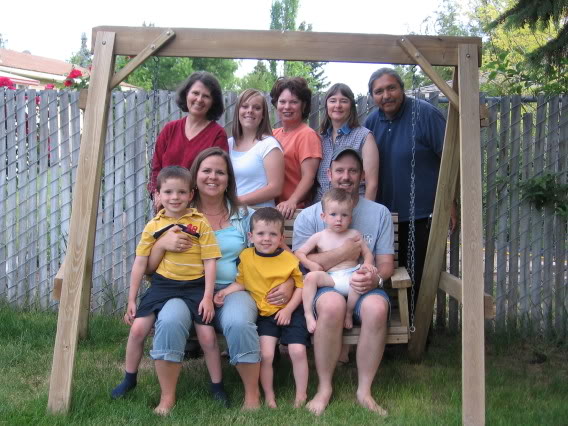
Here is our outreach team a week before we head out. Yes, that is us taking our 3 boys with us to Germany. We believe God has a special impartation for them there, and are excited to bring them!
Top, L to R
Marsha, Hailie, Angela, Peggy, and Lee.
Bottom, L to R
Nathan, Beccy, Matthew, Caleb, and me (the one in the hat, not the diaper).
by Jason Joyner | Jun 30, 2006 | Blog, Uncategorized
Here we are on the third and last day of the Waking Lazarus blog tour, in which I attempt to sound erudite and also like I know something, as I discuss my impressions of TL Hines’ debut.
I must put two small caveats up front: I was going through an intensely stressful time while reading this, and one of the characters hit home for me very closely. I don’t think it colors anything, but there’s the disclaimer.
Actually, I quite enjoyed the book. I think I would have enjoyed it more if it was a fun read, rather than a “escape the world quick!” read. The first chapter definitely sucks you in. If the line, “The first time Jude Allman died, he was eight years old,” doesn’t at least pique your curiosity, then you too may be dead. Be sure to check out the first chapter at www.tlhines.com.
He does a very good job with building the characterization of Jude Allman, a man who has died 3 times and became a reluctant celebrity because of it. He disappears and hides under a false identity in the small town of Red Lodge, Montana, and works quietly as a janitor until he has a strange visitor and bad things start happening around town. We get into Jude’s head and his paranoia he deals with due to his prior life, breaking a few literary standards in the process (at least, one doesn’t normally see some of the techniques he uses).
The action builds up well and keeps the pages turning. When it seems the bad guy will be foiled too soon, there’s a couple of twists and the story keeps going. I felt that he gives away Jude’s three near death experiences a little too soon in the story, as these flashbacks seemed to really set my anticipation for what was happening, but it doesn’t distract either.
The tone is a little dark. As mentioned in Tony’s interview yesterday (see below), the antagonist is the Hunter, and he is a serial kidnapper. This can be a little disconcerting, especially when someone has kids. The very squemish may have a problem here, but any gory details are kept far off-screen (page?). One of his influences is Stephen King, but unlike his books, there is hope at the end.
There’s a spiritual theme that weaves in and out of the story, and it feels appropriate to the story and characters. It’s not tacked on to make this part of the Christian fiction fold; in fact, it can be enjoyed by anyone and they won’t feel preached at or intruded upon. It’s a nice touch overall.
I would rate this book highly as a very good debut novel. I look forward to seeing what comes next from the mind of TL Hines. He says part of his inspiration for WL was working cleaning cadaver labs in college, and picturing them sitting up and talking to him. I don’t know what other inspirations he has for stories, but if they entertain and cause suspense like WL, then I won’t care – I’ll just enjoy reading them!
by Jason Joyner | Jun 30, 2006 | Blog, Uncategorized
Here we are on the third and last day of the Waking Lazarus blog tour, in which I attempt to sound erudite and also like I know something, as I discuss my impressions of TL Hines’ debut.
I must put two small caveats up front: I was going through an intensely stressful time while reading this, and one of the characters hit home for me very closely. I don’t think it colors anything, but there’s the disclaimer.
Actually, I quite enjoyed the book. I think I would have enjoyed it more if it was a fun read, rather than a “escape the world quick!” read. The first chapter definitely sucks you in. If the line, “The first time Jude Allman died, he was eight years old,” doesn’t at least pique your curiosity, then you too may be dead. Be sure to check out the first chapter at www.tlhines.com.
He does a very good job with building the characterization of Jude Allman, a man who has died 3 times and became a reluctant celebrity because of it. He disappears and hides under a false identity in the small town of Red Lodge, Montana, and works quietly as a janitor until he has a strange visitor and bad things start happening around town. We get into Jude’s head and his paranoia he deals with due to his prior life, breaking a few literary standards in the process (at least, one doesn’t normally see some of the techniques he uses).
The action builds up well and keeps the pages turning. When it seems the bad guy will be foiled too soon, there’s a couple of twists and the story keeps going. I felt that he gives away Jude’s three near death experiences a little too soon in the story, as these flashbacks seemed to really set my anticipation for what was happening, but it doesn’t distract either.
The tone is a little dark. As mentioned in Tony’s interview yesterday (see below), the antagonist is the Hunter, and he is a serial kidnapper. This can be a little disconcerting, especially when someone has kids. The very squemish may have a problem here, but any gory details are kept far off-screen (page?). One of his influences is Stephen King, but unlike his books, there is hope at the end.
There’s a spiritual theme that weaves in and out of the story, and it feels appropriate to the story and characters. It’s not tacked on to make this part of the Christian fiction fold; in fact, it can be enjoyed by anyone and they won’t feel preached at or intruded upon. It’s a nice touch overall.
I would rate this book highly as a very good debut novel. I look forward to seeing what comes next from the mind of TL Hines. He says part of his inspiration for WL was working cleaning cadaver labs in college, and picturing them sitting up and talking to him. I don’t know what other inspirations he has for stories, but if they entertain and cause suspense like WL, then I won’t care – I’ll just enjoy reading them!
by Jason Joyner | Jun 29, 2006 | Blog, Uncategorized
Welcome to day 2 of the Waking Lazarus blog tour, featuring the new shining light of the literary world, TL Hines. Today I have my first author interview. Hopefully these are some interesting questions. See what Tony has to say about writing, pants, and the Doors!
1. What got you started in writing fiction?
It’s been a dream of mine–ever since I discovered “The Shining” byStephen King at age 12 and realized, for the first time, that books were written by people. Before that, I think I’d kind of assumed books were these products that rolled off the assembly line like cans of corn. Probably because most of my reading, to that point, had beenHardy Boys mysteries…which really DID roll off an assembly line. So,I started writing then. I didn’t seriously pursue fiction for many years, though, because I was writing all kinds of otherstuff–articles, ads and such. But when C.J. Box, a good friend, had his first book published a few years ago, he inspired/encouraged me to concentrate on fiction again.
2. How long did it take you to write Waking Lazarus? How did you work it in with whatever your “day job” was at the time?
A few weeks of outlining, about two months of writing, and several more months of tweaks and edits. My prime writing time was (and still is) roughly from 5:00 am to 7:00 am each morning. I put on my iPod, open my Powerbook and go to work before I head to my “day job” in advertising. Had I been writing the book full-time, I think I could have turned it out in a few months. Then again, there’s something nice about writing for a few hours in the morning, then letting your subconscious mind process the story until the next morning.
3. How do you think the typical CBA reader react to your antagonist?
The Hunter (the antagonist’s self-imposed nickname) abducts children, and he’s not exactly a well-balanced individual. To tell the truth,I’ve been worried about reaction to the Hunter; I still picture nice folks at my church moving down a few pews after reading the book. But by and large, the reaction has been overwhelmingly positive so far. I purposely avoid graphic descriptions, letting most of the bad stuff happen off-stage–and in the reader’s mind. One email I recently received from an advance reader said, “The PUBLISHERS WEEKLY review said it was grisly, but gee, nothing went squish.” Bingo; it reallyisn’t grisly. Creepy? Yes. I hope so, anyway.
But here’s the other thing: I don’t know if there’s a typical CBA reader anymore. There’s so much variety now–a very good thing–that we’re seeing successful niches develop. It’s not just “ChristianFiction” or “Religious Fiction” now; there’s suspense, historical, speculative, you name it. It’s a pretty exciting time in CBA fiction, I think.
4.What is the weirdest thing that happened to you while writing Waking Lazarus? (Hopefully you don’t say “coming back from the dead!”)
Hmm, this is the first time I’ve been asked something like this. Nope,I didn’t come back from the dead, but I did fall through the ice and almost drown when I was very young–much like Jude Allman does in thefirst chapter of WAKING LAZARUS. When I wrote WAKING LAZARUS, I was going through an incredibly stressful time with my company; my wife and I were merging our advertising agency with another agency, and I think a lot of that stress and angst helped fuel the story. Don’t know if a company merger counts as “weird,” but it was definitely the major life event happening at that time. Maybe some good fodder for Freudian psychoanalysis.
5. Where do you see Christian fiction going?
As I said before, I think this is an exciting time in Christian fiction–it’s healthy and growing, and pulling in more genres. It’s even making some great multicultural strides, I think, which is wonderful to see. You know, people see Christian fiction as some kind of backwater to ABA fiction, but I don’t buy into that at all. I have friends who have published ABA novels, and my publisher, Bethany House, has far and away done more for me than the NY houses do for their debut authors. I think I can unequivocally say I received a better deal all around with Bethany House than I would have with any ABA house. And that’s great news for people writing faith-based stories. The market is growing, and CBA houses are looking for material.
6. Where did the idea for your unique marketing campaign, The Other Side, come from? (other than a Doors song ;))
You know, I thought I was ultra-clever by making the address for the Other Side project http://www.tlhines.com/breakonthrough. My nod to Jim Morrison. But I think you’re the first person to comment on the Doors connection; maybe no one likes the Doors anymore. Anyway, the Other Side was partly inspired by the Open Source software movement, where software designers and engineers offer their base code to a community of other developers and then fold the efforts of those developers back into the core product. It’s a true community effort. I wanted to capture something of that for my novel, so I created the Other Side as a project for people willing to sign up as Volunteer Publicists. In return for telling others about the book, Volunteer Publicists get inside information–including more than 100 background notes about the book’s creation–as well as the chance to win prizes such as an iPod Nano, a share of my first royalty statement, or a role in my next novel.
7. Are you a pantser or a plotter?
Ah, the age-old debate. And I can be a true politician by saying: I’m both. I’ve outlined novels, and found the outlining really helped me stay focused and on task. I’ve gone SOTP for others, and ended uptaking about twice as much time–but ended up with what I feel are better, more unpredictable stories. So I see strengths of both approaches, which is how I developed my own method. First, I write every story as a screenplay, which comes in at roughly 100 pages and gives me key dialogue and scenes. Then, I use that screenplay as my novel outline, adding meat to the structure. This lets me “discover” the story as I write the screenplay, but also gives me focus and direction for the first draft of the novel.
8. Who are your literary influences?
I already mentioned Stephen King, who has probably been my main influence. I tend to gravitate toward crime fiction and slipstream fiction–anything set in the “real” world, but incorporating some fantastic element. Crime fiction novelists I admire include C.J. Box, Elmore Leonard, George Pelecanos and James Lee Burke. Anyone who writes supernatural stuff in the CBA realm owes a debt of gratitude to Peretti and Dekker, of course. Slipstream novelists include Bradbury, NeilGaiman, James Blaylock, and William Hjortsberg.
9. Any advice for aspiring writers?
It’s old, and it’s tired, but the best advice is: write. Just write,and let the other things fall into place. Don’t make publication the be-all and end-all goal of what you do. I made that mistake, and oddly enough, didn’t receive a contract until I’d given up that overwhelming desire to be published. I don’t think that was any coincidence.
10. Can you give us any hints about your next project?
Sure. I’m working on book #2 for Bethany House right now, which will release next summer. It’s tentatively called VALLEY OF SHADOW, and it’s about a young woman who hears the voice of her dead father speaking to her from the shadows. He tells her the spirits of the dead occupy the shadows of our world, and convinces her to join a secret government network that communicates with the shadow operatives. But all is not as it seems. Soon, she discovers the true nature of the shadows–and the true nature of what they want.
Check back tomorrow for my review. I’ll see if I can be an impartial reviewer, and not a slobbering fanboy!
by Jason Joyner | Jun 29, 2006 | Blog, Uncategorized
Welcome to day 2 of the Waking Lazarus blog tour, featuring the new shining light of the literary world, TL Hines. Today I have my first author interview. Hopefully these are some interesting questions. See what Tony has to say about writing, pants, and the Doors!
1. What got you started in writing fiction?
It’s been a dream of mine–ever since I discovered “The Shining” byStephen King at age 12 and realized, for the first time, that books were written by people. Before that, I think I’d kind of assumed books were these products that rolled off the assembly line like cans of corn. Probably because most of my reading, to that point, had beenHardy Boys mysteries…which really DID roll off an assembly line. So,I started writing then. I didn’t seriously pursue fiction for many years, though, because I was writing all kinds of otherstuff–articles, ads and such. But when C.J. Box, a good friend, had his first book published a few years ago, he inspired/encouraged me to concentrate on fiction again.
2. How long did it take you to write Waking Lazarus? How did you work it in with whatever your “day job” was at the time?
A few weeks of outlining, about two months of writing, and several more months of tweaks and edits. My prime writing time was (and still is) roughly from 5:00 am to 7:00 am each morning. I put on my iPod, open my Powerbook and go to work before I head to my “day job” in advertising. Had I been writing the book full-time, I think I could have turned it out in a few months. Then again, there’s something nice about writing for a few hours in the morning, then letting your subconscious mind process the story until the next morning.
3. How do you think the typical CBA reader react to your antagonist?
The Hunter (the antagonist’s self-imposed nickname) abducts children, and he’s not exactly a well-balanced individual. To tell the truth,I’ve been worried about reaction to the Hunter; I still picture nice folks at my church moving down a few pews after reading the book. But by and large, the reaction has been overwhelmingly positive so far. I purposely avoid graphic descriptions, letting most of the bad stuff happen off-stage–and in the reader’s mind. One email I recently received from an advance reader said, “The PUBLISHERS WEEKLY review said it was grisly, but gee, nothing went squish.” Bingo; it reallyisn’t grisly. Creepy? Yes. I hope so, anyway.
But here’s the other thing: I don’t know if there’s a typical CBA reader anymore. There’s so much variety now–a very good thing–that we’re seeing successful niches develop. It’s not just “ChristianFiction” or “Religious Fiction” now; there’s suspense, historical, speculative, you name it. It’s a pretty exciting time in CBA fiction, I think.
4.What is the weirdest thing that happened to you while writing Waking Lazarus? (Hopefully you don’t say “coming back from the dead!”)
Hmm, this is the first time I’ve been asked something like this. Nope,I didn’t come back from the dead, but I did fall through the ice and almost drown when I was very young–much like Jude Allman does in thefirst chapter of WAKING LAZARUS. When I wrote WAKING LAZARUS, I was going through an incredibly stressful time with my company; my wife and I were merging our advertising agency with another agency, and I think a lot of that stress and angst helped fuel the story. Don’t know if a company merger counts as “weird,” but it was definitely the major life event happening at that time. Maybe some good fodder for Freudian psychoanalysis.
5. Where do you see Christian fiction going?
As I said before, I think this is an exciting time in Christian fiction–it’s healthy and growing, and pulling in more genres. It’s even making some great multicultural strides, I think, which is wonderful to see. You know, people see Christian fiction as some kind of backwater to ABA fiction, but I don’t buy into that at all. I have friends who have published ABA novels, and my publisher, Bethany House, has far and away done more for me than the NY houses do for their debut authors. I think I can unequivocally say I received a better deal all around with Bethany House than I would have with any ABA house. And that’s great news for people writing faith-based stories. The market is growing, and CBA houses are looking for material.
6. Where did the idea for your unique marketing campaign, The Other Side, come from? (other than a Doors song ;))
You know, I thought I was ultra-clever by making the address for the Other Side project http://www.tlhines.com/breakonthrough. My nod to Jim Morrison. But I think you’re the first person to comment on the Doors connection; maybe no one likes the Doors anymore. Anyway, the Other Side was partly inspired by the Open Source software movement, where software designers and engineers offer their base code to a community of other developers and then fold the efforts of those developers back into the core product. It’s a true community effort. I wanted to capture something of that for my novel, so I created the Other Side as a project for people willing to sign up as Volunteer Publicists. In return for telling others about the book, Volunteer Publicists get inside information–including more than 100 background notes about the book’s creation–as well as the chance to win prizes such as an iPod Nano, a share of my first royalty statement, or a role in my next novel.
7. Are you a pantser or a plotter?
Ah, the age-old debate. And I can be a true politician by saying: I’m both. I’ve outlined novels, and found the outlining really helped me stay focused and on task. I’ve gone SOTP for others, and ended uptaking about twice as much time–but ended up with what I feel are better, more unpredictable stories. So I see strengths of both approaches, which is how I developed my own method. First, I write every story as a screenplay, which comes in at roughly 100 pages and gives me key dialogue and scenes. Then, I use that screenplay as my novel outline, adding meat to the structure. This lets me “discover” the story as I write the screenplay, but also gives me focus and direction for the first draft of the novel.
8. Who are your literary influences?
I already mentioned Stephen King, who has probably been my main influence. I tend to gravitate toward crime fiction and slipstream fiction–anything set in the “real” world, but incorporating some fantastic element. Crime fiction novelists I admire include C.J. Box, Elmore Leonard, George Pelecanos and James Lee Burke. Anyone who writes supernatural stuff in the CBA realm owes a debt of gratitude to Peretti and Dekker, of course. Slipstream novelists include Bradbury, NeilGaiman, James Blaylock, and William Hjortsberg.
9. Any advice for aspiring writers?
It’s old, and it’s tired, but the best advice is: write. Just write,and let the other things fall into place. Don’t make publication the be-all and end-all goal of what you do. I made that mistake, and oddly enough, didn’t receive a contract until I’d given up that overwhelming desire to be published. I don’t think that was any coincidence.
10. Can you give us any hints about your next project?
Sure. I’m working on book #2 for Bethany House right now, which will release next summer. It’s tentatively called VALLEY OF SHADOW, and it’s about a young woman who hears the voice of her dead father speaking to her from the shadows. He tells her the spirits of the dead occupy the shadows of our world, and convinces her to join a secret government network that communicates with the shadow operatives. But all is not as it seems. Soon, she discovers the true nature of the shadows–and the true nature of what they want.
Check back tomorrow for my review. I’ll see if I can be an impartial reviewer, and not a slobbering fanboy!
