by Jason Joyner | Feb 24, 2007 | Blog, CFBA, critique, writing craft
I am continuing a discussion brought on by the book of the week for the CFBA blog tour, Wedgewood Grey, and its prequel, Abiding Darkness. I am not the greatest writer or editor in the world, but I’ve been reading a lot of fiction lately, as well as trying to study the craft of fiction. I thought it could be informative to dissect a couple of passages from these books by John Aubrey Anderson.
There are three factors about these books that have drawn my focus over the last two weeks. One is the spiritual message that has greatly encouraged me, but that is a different discussion. The other two are 1) the delightful use of language to paint the setting of rural Mississippi and 2) the great characters that are brought to life by said language. I’ve enjoyed the story presented in his books, but I’ve also tried to pick out the aspects that fuel the entertainment.
I’ve chosen two passages, one from each book, to look at and see how it contributes to what I’ve mentioned above. I’ll quote them without context, and leave this post there. Tomorrow I’ll come back to them and present what I see out of them. If anyone has any comments regarding the passages, please share in the comments and I’ll bring that into the discussion.
From early in Abiding Darkness:
Every day for the rest of his life, he would recall that she had been grinning. She was turning away from him; the movement lifted the short-cut hair in seeming slow-motion, moving it up and away from her like strips of ribbon on a fast carousel. A halo of water droplets escaped the brown tendrils and caught the afternoon sun life dozens of transparent pearls. The pearls arced away from the girl and fell in a perfect circle. Water ran down brown legs from the rolled up overalls, her knobby little knees bent, her body leaned out slightly, tanned arms lifted, and her knees began to straighten. And he’d remember how fast the grin changed to something else.
From 2/3’s through in Wedgewood Grey:
Ceedie stepped close and took the jacket from him. “Put your arm in here, then stand still.” She got him jacketed by standing on her tiptoes. When he was dressed, she patted his good arm and momentarily set the stability of his knees back twenty-four hours when she locked eyes with him. “You stay calm, now, an’ be nice to the other children.”
“Yes, ma’am.” The special attention caused his cheeks to use blood he couldn’t spare.
See you tomorrow for the conclusion…
by Jason Joyner | Feb 24, 2007 | Blog, CFBA, critique, writing craft
I am continuing a discussion brought on by the book of the week for the CFBA blog tour, Wedgewood Grey, and its prequel, Abiding Darkness. I am not the greatest writer or editor in the world, but I’ve been reading a lot of fiction lately, as well as trying to study the craft of fiction. I thought it could be informative to dissect a couple of passages from these books by John Aubrey Anderson.
There are three factors about these books that have drawn my focus over the last two weeks. One is the spiritual message that has greatly encouraged me, but that is a different discussion. The other two are 1) the delightful use of language to paint the setting of rural Mississippi and 2) the great characters that are brought to life by said language. I’ve enjoyed the story presented in his books, but I’ve also tried to pick out the aspects that fuel the entertainment.
I’ve chosen two passages, one from each book, to look at and see how it contributes to what I’ve mentioned above. I’ll quote them without context, and leave this post there. Tomorrow I’ll come back to them and present what I see out of them. If anyone has any comments regarding the passages, please share in the comments and I’ll bring that into the discussion.
From early in Abiding Darkness:
Every day for the rest of his life, he would recall that she had been grinning. She was turning away from him; the movement lifted the short-cut hair in seeming slow-motion, moving it up and away from her like strips of ribbon on a fast carousel. A halo of water droplets escaped the brown tendrils and caught the afternoon sun life dozens of transparent pearls. The pearls arced away from the girl and fell in a perfect circle. Water ran down brown legs from the rolled up overalls, her knobby little knees bent, her body leaned out slightly, tanned arms lifted, and her knees began to straighten. And he’d remember how fast the grin changed to something else.
From 2/3’s through in Wedgewood Grey:
Ceedie stepped close and took the jacket from him. “Put your arm in here, then stand still.” She got him jacketed by standing on her tiptoes. When he was dressed, she patted his good arm and momentarily set the stability of his knees back twenty-four hours when she locked eyes with him. “You stay calm, now, an’ be nice to the other children.”
“Yes, ma’am.” The special attention caused his cheeks to use blood he couldn’t spare.
See you tomorrow for the conclusion…

by Jason Joyner | Feb 23, 2007 | Blog, CFBA, fiction, writing craft
In continuing to highlight Wedgewood Grey, the latest book from John Aubrey Anderson, he was gracious enough to give an interview to some young’n’ blogging up in Idaho.
As his bio says, he was an airline pilot for many years. Doesn’t he just look like one here?
Either tomorrow or Saturday I want to post a couple of snippets from both of his books and talk a little about why the particular sections seemed to work, in my opinion. Please check back and add your comments to the discussion! And now, Mr. Anderson please:
1. How long did it take for the story of the Black or White Chronicles to formulate in your head? What was the process for putting it on the page?
There is no reason why anyone should believe this, but tracking the process behind the writing of these stories could not have been done with a Cray computer. But . . . My first and only effort regarding fiction was a two thousand word story I did for our girls twenty years ago . . . a little thing about choices.
In 1997, I pulled that little story out with plans to wrap it around the gospel. I had in mind using it as an evangelistic tool with a non-Christian friend of ours. I found myself “backstorying” in an effort to “set up” my little scene from the short story. Then, in November of 2002, I woke up to find myself surrounded by two or three hundred thousand words. . .and questions about how to get a novel published.
2. Are there any writing tips that you found valuable in writing WG and AD?
Absolutely. Go to a writers’ conference and learn how to get yourstory organized before you start.
And on a more serious note: Think less of being a writer and more of writing. From a time standpoint, this is the most demanding job I’ve ever job I’ve ever had; one person said, “It’s like having homework for the rest of your life.”
A writer does not have time to plan for future fame . . . he/she has to be writing and rewriting.
3. Are there any plans for a project after the release of Book 3 in The Black or White Chronicles?
God willing, this series will run for six books. After that I’d like to do a devotional book for men. Following the devotional . . . I just can’t say.
4. What type of feedback have you heard from readers regardingspiritual issues in the book?
What I’ve heard has been interesting to say the least. Mostly, I hear from readers who have encountered setbacks that were, in their eyes, obviously demonic in origin . . . usually having to do with interpersonal relationships.
5. What has been your favorite “author moment” so far in your career?
I went to my first-ever writers’ conference, with my first-everproposal, and made an appointment with my first-ever editor. I was carrying a 3-by-5 card and a cup of coffee when I arrived for our talk.
When I sat down, he smiled and said, “Brother, you’re way too laid back.”
I smiled back and told him what we both knew. “I’m not in charge of whether or not this book gets published, and frankly, neither are you. I just came to this conference hoping to trim the odds against me down to about ten-thousand to one.”
He said, “Well, I’ve read your stuff, and you’re sitting on about fifty-fifty.”
THE BLACK OR WHITE CHRONICLES were born right then, right there.
I had heard the words I needed to hear, and I was ready to go home. For the next three days of the conference, at each meal, I had to restrain myself from grabbing the PA away from the conference host and yelling, “Would y’all please vote me off this island.”
by Jason Joyner | Feb 23, 2007 | Blog, CFBA, fiction, writing craft
In continuing to highlight Wedgewood Grey, the latest book from John Aubrey Anderson, he was gracious enough to give an interview to some young’n’ blogging up in Idaho.
As his bio says, he was an airline pilot for many years. Doesn’t he just look like one here?
Either tomorrow or Saturday I want to post a couple of snippets from both of his books and talk a little about why the particular sections seemed to work, in my opinion. Please check back and add your comments to the discussion! And now, Mr. Anderson please:
1. How long did it take for the story of the Black or White Chronicles to formulate in your head? What was the process for putting it on the page?
There is no reason why anyone should believe this, but tracking the process behind the writing of these stories could not have been done with a Cray computer. But . . . My first and only effort regarding fiction was a two thousand word story I did for our girls twenty years ago . . . a little thing about choices.
In 1997, I pulled that little story out with plans to wrap it around the gospel. I had in mind using it as an evangelistic tool with a non-Christian friend of ours. I found myself “backstorying” in an effort to “set up” my little scene from the short story. Then, in November of 2002, I woke up to find myself surrounded by two or three hundred thousand words. . .and questions about how to get a novel published.
2. Are there any writing tips that you found valuable in writing WG and AD?
Absolutely. Go to a writers’ conference and learn how to get yourstory organized before you start.
And on a more serious note: Think less of being a writer and more of writing. From a time standpoint, this is the most demanding job I’ve ever job I’ve ever had; one person said, “It’s like having homework for the rest of your life.”
A writer does not have time to plan for future fame . . . he/she has to be writing and rewriting.
3. Are there any plans for a project after the release of Book 3 in The Black or White Chronicles?
God willing, this series will run for six books. After that I’d like to do a devotional book for men. Following the devotional . . . I just can’t say.
4. What type of feedback have you heard from readers regardingspiritual issues in the book?
What I’ve heard has been interesting to say the least. Mostly, I hear from readers who have encountered setbacks that were, in their eyes, obviously demonic in origin . . . usually having to do with interpersonal relationships.
5. What has been your favorite “author moment” so far in your career?
I went to my first-ever writers’ conference, with my first-everproposal, and made an appointment with my first-ever editor. I was carrying a 3-by-5 card and a cup of coffee when I arrived for our talk.
When I sat down, he smiled and said, “Brother, you’re way too laid back.”
I smiled back and told him what we both knew. “I’m not in charge of whether or not this book gets published, and frankly, neither are you. I just came to this conference hoping to trim the odds against me down to about ten-thousand to one.”
He said, “Well, I’ve read your stuff, and you’re sitting on about fifty-fifty.”
THE BLACK OR WHITE CHRONICLES were born right then, right there.
I had heard the words I needed to hear, and I was ready to go home. For the next three days of the conference, at each meal, I had to restrain myself from grabbing the PA away from the conference host and yelling, “Would y’all please vote me off this island.”

by Jason Joyner | Feb 21, 2007 | Blog, books, CFBA, fiction
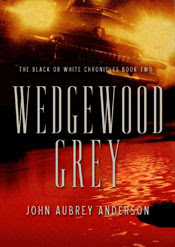
Today’s blog tour is brought to you by the letter “W” and the color Grey. (Sorry, couldn’t resist) Despite the silliness, the CFBA is featuring Wedgewood Grey by John Aubrey Anderson. This is book two in The Black or White Chronicles. I reviewed book one, Abiding Darkness, on Monday, and I encourage you to read it here.
Wedgewood Grey continues the story of Mose Washington, the simple, God-fearing black man in Mississippi from the first book. He comes to the rescue of a black woman and her son, who are being attacked by a group of white teenagers. The consequences of this encounter send Mose and the boy on the run, draws the wrath of a powerful politician, and brings a FBI agent into the chase. The book turns on the theme of our choices, and the effect they have through our lives.
Many characters from Abiding Darkness are brought back into this tale. Anderson continues to delight with wonderful turns of phrase that make me grin, while simultaneously cursing him that he thought of that particular choice of words first! The FBI agent, Jeff Wagner, is an engaging new addition. The young boy rescued by Mose, Bill Prince, is a quieter character, and just isn’t as colorful as some of the others in the Chronicles so far. I was a little disappointed that Missy Parker shows up almost half-way through, and doesn’t have as big an impact in Wedgewood Grey . She was such a dynamic character before, and watching her grow up was so enjoyable, that the grown, mature Missy is a little less of a strength in this book. Also, she was so critical to book one that it is a little curious how she fades here. I am hoping there will be a satisfactory conclusion to this point!
Anderson again shines in drawing out his scenes of action and suspense, never giving us a cheap thrill, but milking it for all it is worth. He is wonderful at foreshadowing, but it is not at all obvious where he is going with it. I had to shake my head at a couple of points, thinking the author got me again!
He continues his habit of changing POV within the same passage. I can overlook this due to the stellar writing. I can also tell a little refinement from Abiding Darkness (not nearly as many characters saying, “Mmmm.”)
Overall, Wedgewood Grey is a wonderful read in its own right, even though I liked Abiding Darkness a little more. The trouble is, the third book in the series, And If I Die, doesn’t come out until August ’07!!! Arrrgh!!!
I am planning to do a little study of a couple passages out of these two books, as well as a mini-interview with John Aubrey Anderson, over the next couple of days. Please come back, check it out, and leave comments. Oh, and check out the new widget from the CFBA, the CFBA Amazon store! Now you can order books from our tours, and other recommended reading, all in one place. Kudos to Bonnie for putting it together!
