by Jason Joyner | Jan 26, 2008 | arts, Biblical worldview, Blog, books, culture
Getting Christians to a consensus on a lot of things can be interesting. However, T.M. Moore from Breakpoint and Chuck Colson’s Centurions project thinks he may have some suggestions on how to do this regarding Christians engaging the culture. This is along the lines of my Seven Spheres series from a week or two ago.
Breakpoint talked about it this week and had this great quote:
How do we do this? Our task is two-fold. First, we must participate in culture at the same time that we are engaged in a biblically based critique of culture. For too long, Christians have ignored the arts and have, thus, failed to realize that culture and the arts can be conduits of God’s truth, grace, and beauty.
Second, as the body of Christ, we need to support those among us who exercise their God-given artistic gifts. When we join together “for creative engagement in culture matters,” T. M. argues, we can “create a greater sense of unity in the body of Christ,” as well as increase our impact on culture.
Read the whole article here. I haven’t read the book yet, but I’ll be interested to check out Culture Matters down the road.
by Jason Joyner | Jan 24, 2008 | Auralia's Colors, Blog, CSFF, reviews, speculative fiction
I just had a couple of final thoughts on Auralia’s Colors.
1. Robert Treskillard described the book as being “poetic”. Dang! That was the word I was searching for all night writing my post, and I couldn’t come up with it. It is definitely a poetic book.
2. Marcus Goodyear commented “Funny that you describe the book as “truly an amazing accomplishment” but then say it isn’t one of your favorites. Did you find yourself appreciating the artistry without being engaged in the story?”
Appreciating the artistry is pretty close. Let me say it this way: I really enjoyed the book overall. When I compare it to books I considered my favorites of 2007, it didn’t quite make the list. However, in my opinion it is a very key book for Christian fiction. Overstreet gives us a book that challenges the boundaries of what Christian sci-fi and fantasy can be. It tells a story artfully and boldly, without having to explain to the reader every detail of what is meant from the story.
I was engaged with the story to a great degree, but there was a little that held back. There was a little distance to it. As I said yesterday, it seemed to be part of a grander vision, but lacked a little of what it needed to stand on its own.
Overall, the use of language and the challenge Overstreet set for himself in telling his story is what made me describe it as an amazing accomplishment. I think I can appreciate that without it being one of my top favorites (not to say that I didn’t really enjoy it). Is it analogous to saying I know that Beethoven is a master, but I prefer Bach? Perhaps.
So, if you haven’t read Auralia’s Color, then I do encourage you to take a look at it and give it a chance. I think you’ll be rewarded if you do.
by Jason Joyner | Jan 24, 2008 | Auralia's Colors, Blog, CSFF, reviews, speculative fiction
I just had a couple of final thoughts on Auralia’s Colors.
1. Robert Treskillard described the book as being “poetic”. Dang! That was the word I was searching for all night writing my post, and I couldn’t come up with it. It is definitely a poetic book.
2. Marcus Goodyear commented “Funny that you describe the book as “truly an amazing accomplishment” but then say it isn’t one of your favorites. Did you find yourself appreciating the artistry without being engaged in the story?”
Appreciating the artistry is pretty close. Let me say it this way: I really enjoyed the book overall. When I compare it to books I considered my favorites of 2007, it didn’t quite make the list. However, in my opinion it is a very key book for Christian fiction. Overstreet gives us a book that challenges the boundaries of what Christian sci-fi and fantasy can be. It tells a story artfully and boldly, without having to explain to the reader every detail of what is meant from the story.
I was engaged with the story to a great degree, but there was a little that held back. There was a little distance to it. As I said yesterday, it seemed to be part of a grander vision, but lacked a little of what it needed to stand on its own.
Overall, the use of language and the challenge Overstreet set for himself in telling his story is what made me describe it as an amazing accomplishment. I think I can appreciate that without it being one of my top favorites (not to say that I didn’t really enjoy it). Is it analogous to saying I know that Beethoven is a master, but I prefer Bach? Perhaps.
So, if you haven’t read Auralia’s Color, then I do encourage you to take a look at it and give it a chance. I think you’ll be rewarded if you do.
by Jason Joyner | Jan 23, 2008 | Auralia's Colors, Blog, CSFF, reviews, speculative fiction
An Impressive Palette
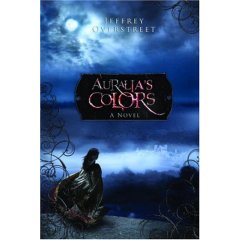
At first glance, Auralia’s Colors may have a beautiful cover with an intriguing back copy. I was interested when hearing about the book a few months ago on Becky Miller’s blog. What you get when you open the pages is the literary equivalent of a master tapestry.
Trying to write a book that prominently features colors is an inspiration that I don’t envy. However, Jeffrey Overstreet’s first novel is truly an amazing accomplishment.
It doesn’t really have a comparison in Christian fiction. That is definitely a good thing (as it shows that this “genre” is growing), but it can be a little harder to characterize it then.
I haven’t been to a lot of blogs on this tour yet, but one word that keeps coming up is literary. I think what is meant by that is that the book treats language as a beautiful thing in and of itself, rather than being secondary to the plot or action. The book seems to be carefully crafted, and the choice of words is very picturesque. Even though a major theme is color and beauty, the descriptions of birds taking flight, people’s reactions, and other things that could be mundane paint just as compelling of imagery in the reader’s mind.
The book takes chances aplenty, and it wins on a lot of them. One of the main characters is only called “ale boy” throughout the book. The plot zigs instead of zagging. There are surprises toward the end that I really didn’t see coming. The themes are deeply spiritual, but not clearly allegorical: you can not pin “this is Jesus” on one character and “this is Satan” on another. The mysterious Keeper stays mysterious throughout, and it is not fully revealed. It allows the reader to mine their own conclusions from the book.
Even though this book was very enjoyable, it didn’t quite make my list of top books for 2007. I’m sure part of this is just my taste in books – I am usually drawn to a little more fast and furious. Still, some of the plot took a long time to describe without discernible payoff later on in the book, and overall the book seems a little too much like a set-up for the whole series. I am sure it is a very hard thing to make one book self-sufficient and inclusive when imagining a whole series, but as I think about it, this is the reason that the book didn’t fully resonate with me.
Overall, this book is a very welcome entry into Christian fiction, and is a well-crafted, entertaining work that should be read by any fan of fantasy. This colorful literature is one of the most important books in Christian speculative fiction in a long time, due to its creativity and daring.
by Jason Joyner | Jan 23, 2008 | Auralia's Colors, Blog, CSFF, reviews, speculative fiction
An Impressive Palette
At first glance, Auralia’s Colors may have a beautiful cover with an intriguing back copy. I was interested when hearing about the book a few months ago on Becky Miller’s blog. What you get when you open the pages is the literary equivalent of a master tapestry.
Trying to write a book that prominently features colors is an inspiration that I don’t envy. However, Jeffrey Overstreet’s first novel is truly an amazing accomplishment.
It doesn’t really have a comparison in Christian fiction. That is definitely a good thing (as it shows that this “genre” is growing), but it can be a little harder to characterize it then.
I haven’t been to a lot of blogs on this tour yet, but one word that keeps coming up is literary. I think what is meant by that is that the book treats language as a beautiful thing in and of itself, rather than being secondary to the plot or action. The book seems to be carefully crafted, and the choice of words is very picturesque. Even though a major theme is color and beauty, the descriptions of birds taking flight, people’s reactions, and other things that could be mundane paint just as compelling of imagery in the reader’s mind.
The book takes chances aplenty, and it wins on a lot of them. One of the main characters is only called “ale boy” throughout the book. The plot zigs instead of zagging. There are surprises toward the end that I really didn’t see coming. The themes are deeply spiritual, but not clearly allegorical: you can not pin “this is Jesus” on one character and “this is Satan” on another. The mysterious Keeper stays mysterious throughout, and it is not fully revealed. It allows the reader to mine their own conclusions from the book.
Even though this book was very enjoyable, it didn’t quite make my list of top books for 2007. I’m sure part of this is just my taste in books – I am usually drawn to a little more fast and furious. Still, some of the plot took a long time to describe without discernible payoff later on in the book, and overall the book seems a little too much like a set-up for the whole series. I am sure it is a very hard thing to make one book self-sufficient and inclusive when imagining a whole series, but as I think about it, this is the reason that the book didn’t fully resonate with me.
Overall, this book is a very welcome entry into Christian fiction, and is a well-crafted, entertaining work that should be read by any fan of fantasy. This colorful literature is one of the most important books in Christian speculative fiction in a long time, due to its creativity and daring.
